What Your AMH Test Says Beyond Fertility
Key Highlights
- An AMH test measures anti-Müllerian hormone, which reflects the approximate number of follicles remaining in the ovaries, often called ovarian reserve.
- AMH helps predict how the ovaries may respond to fertility treatment, but it is a poor predictor of natural conception for an individual woman.
- AMH levels decline gradually with age, and researchers are studying whether that decline can help estimate the timing of menopause.
- Studies have observed associations between AMH and bone and cardiovascular health, although these uses are not yet part of routine clinical practice.
- An AMH result is most useful when interpreted alongside other hormone tests and a clinical consultation, rather than read as a standalone score.
Quick Summary
An AMH test is usually ordered for one reason: to assess ovarian reserve before fertility treatment. Outside that setting, the result is rarely discussed, and many women who receive one are left unsure what the number actually means.
Researchers are now looking at AMH more broadly, as a possible early signal for menopause timing and the changes that follow it. This article explains what the test measures, what it can and cannot tell you, and how to read the result sensibly.
What AMH Measures
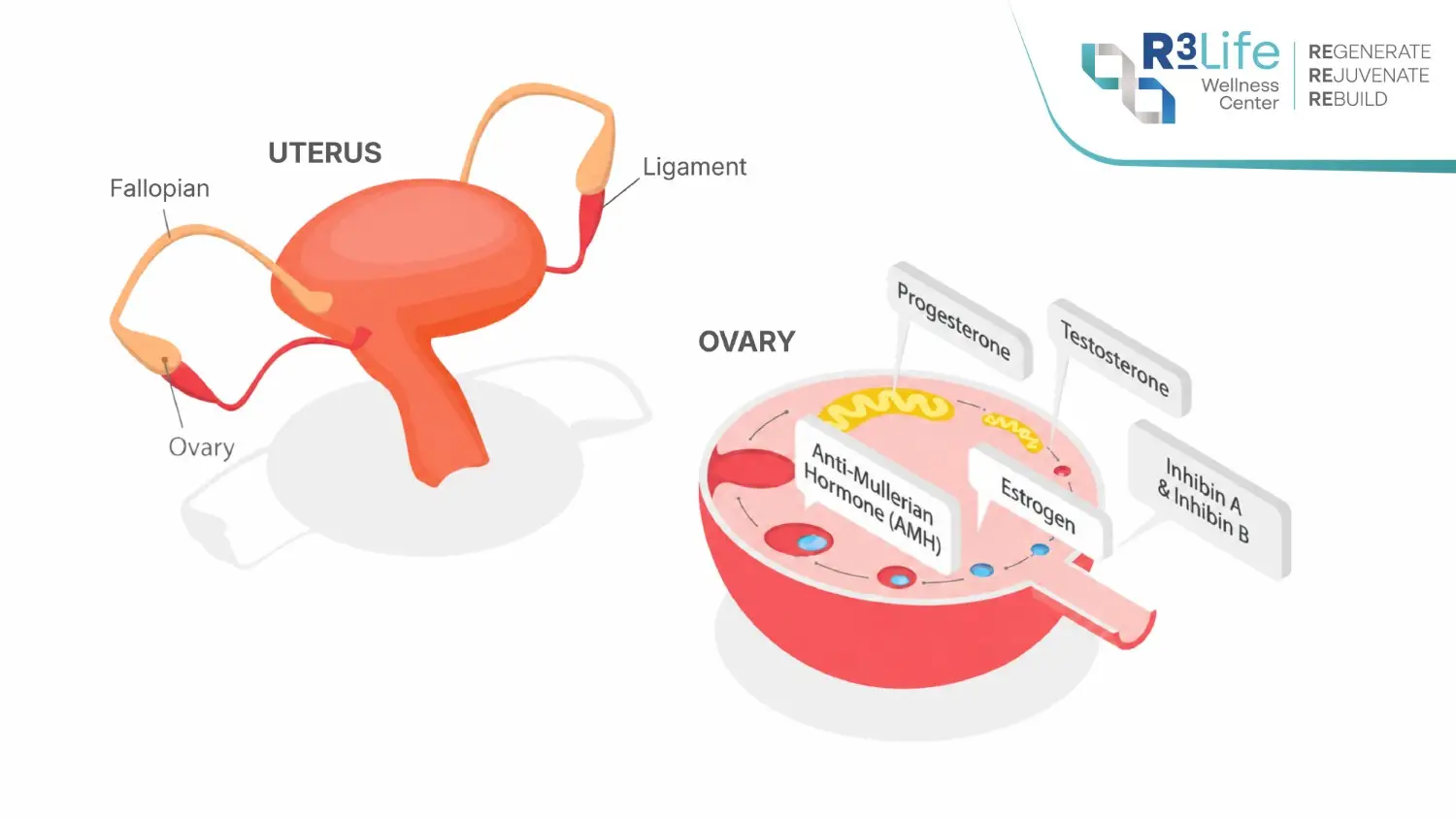
Anti-Müllerian hormone, or AMH, is a hormone produced in the ovaries. Where it comes from explains both its uses and its limits.
Where the Hormone Comes From
AMH is produced by cells in small, developing follicles. Because the number of these follicles reflects the wider pool of eggs remaining, AMH serves as an indirect estimate of ovarian reserve. It reflects quantity, not egg quality.
An AMH test does not tell you exactly how many eggs you have. Instead, results are generally read as a broad indication of whether ovarian reserve appears high, normal, low, or very low for your age. For a more detailed picture, an obstetrician-gynecologist (OB-GYN) may recommend a transvaginal ultrasound to count antral follicles, and review both results together.
Why It Declines With Age
AMH levels by age follow a familiar pattern: they typically peak in the early-to-mid 20s, then decline gradually, becoming very low as menopause approaches. The trend is steady across populations, but women of the same age can have very different results.
What It Is Conventionally Used For
In current practice, AMH is used mainly in reproductive medicine:
- Estimating how the ovaries may respond to stimulation during IVF or egg freezing
- Informing conversations about fertility planning and timelines
- Helping to assess polycystic ovary syndrome (PCOS). AMH is often higher in PCOS, and the 2023 international PCOS guideline recognizes it as an alternative to ultrasound for identifying polycystic ovaries in adults, though not in adolescents
AMH cannot tell you whether you will get pregnant naturally, or how long it might take. Many women with low AMH still conceive naturally, and a normal result is not a guarantee of pregnancy. Fertility depends on several other factors, including egg quality, ovulation, fallopian tube health, and sperm health.

Why Researchers Look at AMH Beyond Fertility
Because AMH tracks the gradual decline of ovarian reserve, researchers are studying whether it can say something about the years that follow. The findings so far are associations rather than established clinical uses.
AMH as a Signal of Menopause Timing
Lower AMH levels for a given age have been associated with earlier menopause in several studies. Researchers are developing models that combine AMH with age and other factors to estimate timing. So far, these estimates work better across groups than for predicting an exact age for any one woman.
Observed Associations With Bone Density
Bone loss accelerates around menopause as estrogen declines. Some studies have explored whether falling AMH can signal that this phase is approaching, which could help women plan bone health measures earlier. This remains a research question rather than a routine reason to test.
Observed Associations With Cardiovascular Risk
Earlier menopause is associated with higher long-term cardiovascular risk. Because AMH relates to menopause timing, researchers are studying whether it adds useful information about cardiovascular health. Findings are mixed and not yet used to guide care.
How to Read the Result Sensibly
An AMH number can feel definitive. In practice, it needs context.
What a Low Result Does Not Mean
A low AMH result does not mean:
- That natural conception is impossible or unlikely
- That menopause is imminent
- That something is medically wrong
It indicates a smaller remaining follicle pool than average for age. That is useful information for planning, not a verdict.
Why It Is One Marker Among Several
Several factors can influence an AMH result, including hormonal contraception, which may lower readings temporarily, and differences between laboratory methods. Results are best read alongside other hormone tests and your cycle history, and compared using the same laboratory over time.
Where the Evidence Is Still Emerging
The fertility uses of AMH are well established. Its role in estimating menopause timing is promising but imprecise, and its links with bone and cardiovascular health are still being studied. An honest reading keeps these categories separate.
Who Might Consider Testing
An AMH test is most informative when there is a specific question it can help answer.
Age Ranges Where the Signal Is Most Informative
For fertility planning, AMH is most commonly considered from the late 20s through the early 40s. For questions about approaching menopause, it tends to be most relevant from the late 30s onward, when levels are falling and timing becomes a practical concern.
What to Pair It With
AMH is more useful as part of a wider picture. At R3 Life Wellness Center, Pre-Health Screening can provide that context:
- Hormone Test for Female, covering FSH, LH, estradiol, progesterone, testosterone, and thyroid markers
- Vitamin D Level Test, relevant to longer-term bone health planning
- Universe Health Check Up, covering blood sugar, lipid profile, and liver and kidney function
A result you can act on requires someone to interpret it. The consultation, not the number, is where an AMH result becomes useful.
Frequently Asked Questions About the AMH Test
Q: My AMH is low for my age. Should I freeze my eggs now?
A: A low result may make timing more relevant, but it is not a decision on its own. Egg freezing decisions depend on your age, personal plans, and a fertility specialist's assessment, including ultrasound. A low AMH is a reason to have that conversation sooner, not a reason to panic.
Q: Can an AMH test tell me when I will reach menopause?
A: Lower AMH for your age has been associated with earlier menopause, but current models give a broad range rather than a specific age. Tracking results over time alongside your cycle pattern tends to be more informative than a single test.
Q: Does hormonal contraception affect my AMH result?
A: It can. Some studies have found that hormonal contraception may lower AMH readings, with levels rising again after stopping. Tell your physician what you are taking so the result can be read in context.
Q: Is an AMH test worth doing if I am not planning a pregnancy?
A: It can be, if you want a clearer picture of your reproductive timeline or you are planning ahead for health after menopause. At R3 Life, hormone results are reviewed in a physician consultation, so the number is placed in the context of your age, history, and goals.
Conclusion: Understanding the Person Behind the Result
An AMH result is only one part of your health story. At R3 Life Wellness Center, we start by listening: understanding your lifestyle, health history, concerns, and where you are in life before deciding what information may actually be useful for you.
Depending on your individual needs, your physician may consider AMH alongside other hormone, nutritional, metabolic, or health markers to build a more complete picture.
The goal is not to test everything. It is to understand what matters to you, interpret the right information in context, and help you plan your health in a way that fits your life.
Because the consultation, not the number, is where an AMH result becomes useful. To discuss hormone testing and what your results mean, contact R3 Life Wellness Center at r3lifewellness.com or via WhatsApp at +66 88 689 8888.

 Vibrant Lifestyle Spots Silom-Surawong’s Trendy Hotspots