Premium DNA Health Profile Bangkok: Stop Guessing | R3 Life
Eating clean and training hard but still stuck? One whole exome DNA test, 500+ insights, 20+ categories and a doctor-built plan at R3 Life Bangkok.
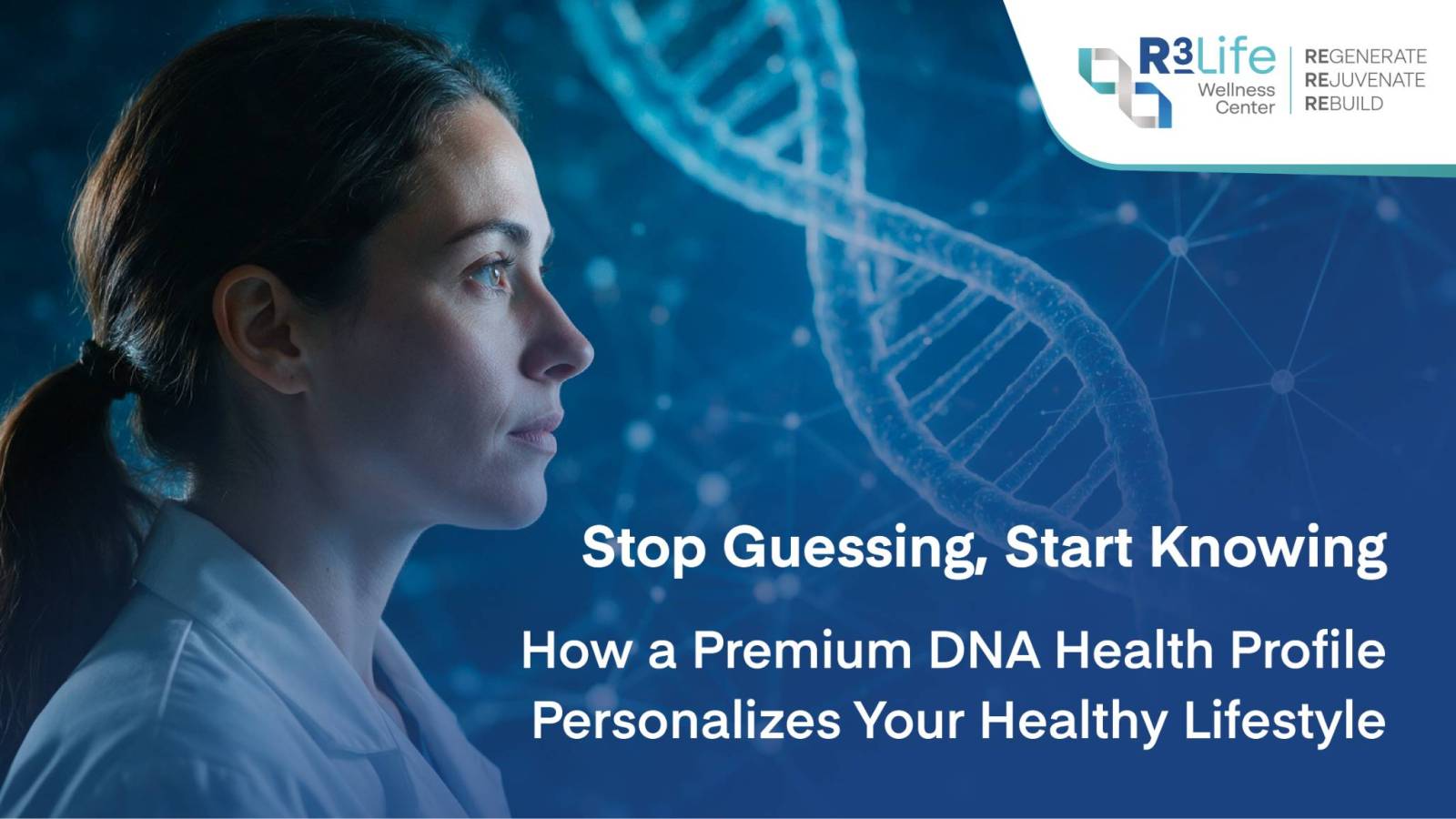
Stop Guessing, Start Knowing: How a Premium DNA Health Profile Personalizes Your Healthy Lifestyle
Key takeaways
- Your metabolism is not the reason things feel harder in your 30s. A landmark study in Science found energy expenditure stays remarkably stable from age 20 to 60.
- The same meal can produce very different responses in different people, which is why "healthy" advice that works for your friend may not work for you.
- A single cheek-swab Premium DNA Health Profile, powered by Whole Exome Sequencing, gives you 500+ insights across 20+ categories: diet, nutrients, fitness, sleep, stress, skin and healthy aging.
- Your DNA doesn't change, so you test once and use the results for life.
- At R3 Life, a physician in anti-aging and regenerative medicine reads your results with you and turns them into a personalized plan.
The "I'm Already Healthy" Paradox
Picture a 34-year-old who is, by every visible measure, doing it right. She drinks a flat white at 7 a.m. and another at 2 p.m. Breakfast is a whey protein smoothie with banana and oat milk. She does HIIT four times a week, because everyone says it's the most efficient workout. Lunch is a poke bowl. She takes a multivitamin "just in case." She goes to bed at 11 p.m. like the sleep experts recommend.
And yet: she wakes up tired, her afternoon energy crashes, the scale won't budge past a certain point, and her knees complain after every session in a way they never did at 27.
She's not lazy. She's not undisciplined. She's following a plan. The problem is the plan was written for an average person, and nobody is average.
That's the gap a Premium DNA Health Profile is designed to close.

First, Let's Clear the Name of Your Metabolism
The most common thing people in their early-to-mid 30s tell us is: "My metabolism is slowing down."
Here's the surprising science. In 2021, a team led by Herman Pontzer analyzed energy expenditure data from more than 6,400 people aged 8 days to 95 years. Their finding, published in Science: once you adjust for body size and composition, daily energy expenditure stays essentially flat from age 20 to 60. It only starts declining, at about 0.7% a year, after 60. (Reference: Pontzer et al., Science, 2021)
So if it's not your metabolism, what is it?
Two things tend to shift in your 30s:
- Your margin for error shrinks. At 25, your body quietly absorbed mismatched habits. At 35, it starts sending the bill: slower recovery, lighter sleep, stubborn weight.
- Muscle starts to go. Adults can lose roughly 3% to 5% of muscle mass per decade after 30 without targeted strength work (Reference: Cleveland Clinic, Sarcopenia). Less muscle means different fuel needs and different training priorities.
In other words, this is the decade when generic stops being good enough and specific starts to matter.
Same Meal, Different Body: Why "Healthy" Isn't Universal
If you've ever eaten the exact same lunch as a friend and felt completely different afterward, science has your back.
The PREDICT study, published in Nature Medicine in 2020, fed more than 1,000 adults (including identical twins) standardized meals and tracked what happened next. The results were striking: responses to identical meals varied enormously between people, with blood sugar responses varying by 68% and blood fat responses by 103%. (Reference: Berry et al., Nature Medicine, 2020)
Your response to food is shaped by many things: your gut microbiome, sleep, meal timing, activity and, yes, your genes. Your genes are the one layer that never changes. That makes them the ideal starting point, the foundation you build everything else on.

5 "Healthy Habits" Your DNA Might Be Quietly Vetoing
Let's go back to our 34-year-old. Here's what her daily routine might look like through a genetic lens.
1. That second coffee
The CYP1A2 gene controls how quickly your liver clears caffeine. Some people are "fast metabolizers." Others are "slow metabolizers," and for them, caffeine lingers much longer in the body.
This isn't just about jitteriness. A well-known study in JAMA followed more than 4,000 people and found that among slow metabolizers, drinking four or more cups of coffee a day was associated with a higher risk of non-fatal heart attack, while fast metabolizers showed no such link. The association was strongest in people under 50. (Reference: Cornelis et al., JAMA, 2006)
For a slow metabolizer, that 2 p.m. flat white may still be circulating at 11 p.m., which could help explain the "I sleep eight hours but wake up tired" problem.
What your report shows: Caffeine Sensitivity, plus related reports on Alcohol, Fat, Carbohydrate and Salt Sensitivity.
2. The whey smoothie
About two-thirds of adults worldwide lose some ability to digest lactose after childhood, and in East and Southeast Asian populations, the proportion is much higher. (Reference: Anguita-Ruiz et al., Nutrients, 2020)
Many whey concentrates and "healthy" dairy-based breakfasts contain lactose. If your genes lean toward lactose intolerance, that morning smoothie may be the reason for the bloating you blamed on "stress."
What your report shows: Lactose Intolerance, Coeliac (gluten) Predisposition, and your Optimal Diet Type.
3. HIIT, four times a week
Fitness culture loves a single "best" workout. Your genes don't. Variants in genes linked to muscle fiber type, oxygen efficiency and lactate clearance can shape whether your body leans toward power or endurance, and how quickly you recover between sessions.
Someone with an endurance-dominant profile and lower recovery efficiency might do better with more steady-state cardio and longer rest days than with back-to-back HIIT.
What your report shows: Optimal Training Type, Power vs. Endurance Capacity, Recovery Efficiency, Injury Risk (including Achilles tendon and ACL), Fatigue Resistance and VO₂ efficiency.
4. The "just in case" multivitamin
A multivitamin is a guess. A genetic nutrient profile is a map. Genes influence how efficiently you absorb and use nutrients like vitamin D, folate, B vitamins, iron and omega-3s. Some people have genetically "higher needs" for specific nutrients and "normal needs" for others.
Instead of a shotgun approach, your report can point to where your body is most likely to need extra support, so supplements become targeted rather than random.
What your report shows: Personalized needs for 20+ nutrients, including Vitamins A, B, C, D and E, Folic Acid, Iron, Magnesium, Zinc, Calcium and four types of Omega-3/Omega-6 fatty acids.
5. The 11 p.m. bedtime
A 2019 study of nearly 700,000 people in Nature Communications identified 351 genetic regions linked to whether you're naturally a morning person or a night owl. (Reference: Jones et al., Nature Communications, 2019)
If you're a genetic night owl forcing an early-bird schedule, you may be fighting your own biology every single night. Knowing your chronotype helps you schedule sleep, workouts and even your most important work around your natural rhythm.
What your report shows: Chronotype, Sleep Depth, Sleep Duration, Sleep Quality, Stress Tolerance ("Warrior" vs. "Worrier") and Stress-Induced Weight Gain.
What's Inside the Premium DNA Health Profile
One test. 500+ insights. 20+ categories. For life.
The Premium DNA Health Profile uses a quick, painless cheek (buccal) swab, analyzed at an internationally accredited laboratory, to build one of the most comprehensive personal health profiles available from a single test.
Why Whole Exome Sequencing matters
Many consumer DNA kits use "genotyping," which checks a pre-selected list of single points in your DNA, a bit like reading only the highlighted words in a book.
The Premium DNA Health Profile uses Whole Exome Sequencing (WES). Instead of spot-checking, it reads your exome: the protein-coding regions of your genes. The exome makes up only around 1% to 2% of your total DNA, but it's the part that carries the instructions your body uses to build proteins, the enzymes, hormones and structural molecules that run everything from caffeine clearance to collagen production. Reading it in full gives a much richer, more detailed picture than spot-checking alone.
| Category | Example insights |
| Diet & Food Sensitivities | Optimal diet type, caffeine, alcohol, carb, fat and salt sensitivity, lactose intolerance, sweet tooth, weight regain risk |
| Nutrient Needs | Personalized needs for vitamins, minerals, antioxidants and omega fatty acids |
| Sports & Fitness | Power vs. endurance, recovery efficiency, injury risk, VO₂ efficiency, lactate clearance |
| Stress & Sleep | Chronotype, sleep depth and quality, stress tolerance |
| Well-Being & Healthy Aging | Inflammatory response, bone mineral density, metabolic response, appetite control |
| Skin | Skin aging tendency, glycation, oxidative stress, hydration, collagen-related traits |
| Health Risk Insights | Genetic predispositions for common health conditions, to discuss with your doctor |
| Precision Medicine | How your genes may influence response to certain medications |
| Family Planning, Ancestry & Personal Traits | Carrier status, ancestry composition, personality and behavioral traits |
Because your DNA is fixed from birth, this is a one-time test. Unlike a blood panel that you repeat every year, your genetic profile remains a reference you can come back to at 35, 45 and 65.

Why Data Alone Isn't Enough (and Why a Doctor Makes the Difference)
Here's a truth most DNA test companies won't tell you: a 500-insight report can be overwhelming. Knowing you're a "slow caffeine metabolizer with higher vitamin D needs and an endurance-dominant profile" is interesting. Knowing exactly what to change on Monday morning is what actually matters.
And the evidence suggests that personal genetic information can be a powerful motivator. In a randomized trial from the University of Toronto, people who received their personal genetic results for caffeine and salt sensitivity reduced their intake of both more than people given standard advice alone. (Reference: Nielsen & El-Sohemy, PLOS ONE, 2014)
That's the principle behind the way R3 Life delivers this test. Your results are read and interpreted by a physician specializing in anti-aging and regenerative medicine, who then designs a care plan around you, bringing together your:
- Nutrition: what to eat more of, what to cut back on, and timing
- Supplements: targeted, based on your genetic needs, not guesswork
- Training: the type, intensity and recovery that suit your body
- Sleep & stress: a schedule that works with your chronotype, not against it
- Healthy aging priorities: which areas deserve the most attention in the decade ahead
Your genes are the foundation. Your doctor helps you build on it.
How It Works
- Book your consultation at R3 Life, Bangkok. Via whatsapp +66 88 689 8888
- Take a gentle cheek swab. No needles, no blood draw, done in minutes. (Avoid eating, drinking, smoking, chewing gum or brushing your teeth shortly before the swab so the sample stays clean.)
- Whole Exome Sequencing at an internationally accredited laboratory.
- Receive your full report in about 45 days, with 500+ insights accessible anytime through a secure mobile app.
- Sit down with your R3 Life physician to interpret the results and build your personalized plan.
Who This Test Is For
The Premium DNA Health Profile is ideal if you:
- Are of any gender and age and want to take a proactive approach to their health and long-term well-being
- Are in your 30s or 40s and are especially encouraged to consider preventive health, with the goal of investing in how they want to feel at 50 and beyond
- Have a family history or risk of certain diseases and want to take proactive steps to monitor, manage, and protect their long-term health
- Already eat well and exercise, but feel their health or wellness goals have plateaued and want a more personalized approach to understanding and optimizing their health
- Are tired of trial and error with diets, supplements and training programs
- Want a data-driven foundation for your long-term healthy aging strategy
- Prefer to make decisions based on your own body, not someone else's
Frequently Asked Questions
1.What is a Premium DNA Health Profile?
It's a comprehensive genetic test that uses Whole Exome Sequencing to analyze your DNA from a simple cheek swab to generate 500+ insights across 20+ health categories, including diet, nutrition, fitness, sleep, stress, skin and healthy aging. At R3 Life, results are reviewed with a physician who creates a personalized care plan.
2.How is a DNA health test different from a regular blood test?
A blood test shows your current state, which changes over time. A DNA test shows your genetic tendencies, which stay the same for life. The two work best together: DNA tells you where your body is predisposed to struggle, and blood tests show how you're doing right now.
3.Do I only need to take the test once?
Yes. Your DNA does not change throughout your life, so a single test gives you a lifelong reference.
4.Does my DNA decide my future health?
No. As geneticists often put it: genes load the gun, but lifestyle pulls the trigger. Your results show predispositions, not destiny, and many of them can be influenced by how you eat, move, sleep and manage stress. The report is not a medical diagnosis.
5.What is Whole Exome Sequencing (WES)?
Whole Exome Sequencing reads the protein-coding regions of your genes (the exome) in full, rather than checking only a pre-selected list of genetic markers. This gives a more comprehensive view of the genetic variants that influence how your body works.
6.Is the test painful?
Not at all. A soft swab is gently rubbed on the inside of your cheek to collect cells. No needles, no blood.
7.How long does it take to get results?
Results are ready in about 45 days after your sample reaches the laboratory. You'll then review them with your R3 Life physician.
8.Is my DNA data kept private and secure?
Yes. Your genetic data is stored and protected according to ISO/IEC 27001, the leading international standard for information security management.
9.I'm already healthy. Is it worth it?
That's exactly who benefits most. If you're already putting in the effort, the test helps make sure the effort is pointed in the right direction for your body.
10.Where can I take the Premium DNA Health Profile in Bangkok?
The Premium DNA Health Profile is available at R3 Life Wellness Center in Bangkok, with physician-led interpretation and a personalized plan included.
Stop Guessing. Start Knowing.
You've already done the hard part. You've built the habits, the discipline, the routine. The only question left is whether that routine is truly made for you.
Face the truth. Dare to know yourself deeper.
👉 [Book your Premium DNA Health Profile at R3 Life]
References
- Pontzer H, et al. Daily energy expenditure through the human life course. Science. 2021;373(6556):808-812. https://www.science.org/doi/10.1126/science.abe5017
- Berry SE, et al. Human postprandial responses to food and potential for precision nutrition. Nature Medicine. 2020;26:964-973. https://www.nature.com/articles/s41591-020-0934-0
- Cornelis MC, et al. Coffee, CYP1A2 genotype, and risk of myocardial infarction. JAMA. 2006;295(10):1135-1141. https://pubmed.ncbi.nlm.nih.gov/16522833/
- Anguita-Ruiz A, et al. Genetics of lactose intolerance: an updated review and online interactive world maps of phenotype and genotype frequencies. Nutrients. 2020;12(9):2689. https://www.mdpi.com/2072-6643/12/9/2689
- Jones SE, et al. Genome-wide association analyses of chronotype in 697,828 individuals provides insights into circadian rhythms. Nature Communications. 2019;10:343. https://www.nature.com/articles/s41467-018-08259-7
- Nielsen DE, El-Sohemy A. Disclosure of genetic information and change in dietary intake: a randomized controlled trial. PLOS ONE. 2014;9(11):e112665. https://journals.plos.org/plosone/article?id=10.1371/journal.pone.0112665
- Cleveland Clinic. Sarcopenia. https://my.clevelandclinic.org/health/diseases/23167-sarcopenia

 Instant Rejuvenation for Those Aged 30+ With Anti-Aging Vitamin Drip at R3 Life Wellness