Insomnia: Why Sleep Quality Matters More Than You Think and How to Improve It
Insomnia is one of the most common sleep disorders worldwide and one of the most searched health concerns related to how to sleep better and how to improve sleep quality naturally.
According to the American Academy of Sleep Medicine, approximately 30–35% of adults experience insomnia symptoms occasionally, and nearly 10% suffer from chronic insomnia disorder.
Insomnia is not simply “going to bed late.” It is a sleep quality problem that affects deep sleep cycles, hormone regulation, immune function, cognitive performance, and long-term metabolic health.
The key question is: how to sleep better at night, and more importantly, how to improve sleep quality in a sustainable and biologically meaningful way?
What Is Insomnia and How Does It Develop?
Insomnia is defined as:
- Difficulty falling asleep
- Frequent night awakenings
- Waking up too early
- Sleeping enough hours but feeling unrefreshed (non-restorative sleep)
Chronic insomnia occurs at least three nights per week for more than three months and is classified as a chronic sleep disorder.
Common causes of insomnia include:
- Chronic stress and insomnia
- Sympathetic nervous system overactivity
- High cortisol levels at night
- Circadian rhythm disruption
Insomnia is often not just a sleep timing issue, but a nervous system imbalance.

Sleep Quality vs Sleep Duration: Is 7 Hours of Sleep Enough?
A common search question is: is 7 hours of sleep enough?
The answer depends on sleep quality vs sleep quantity.
Adults are recommended to sleep 7–9 hours per night. However, deep sleep should account for approximately 15–25% of total sleep time for optimal recovery.
Deep sleep, also known as slow-wave sleep, is the stage when the body:
- Performs cellular repair during sleep
- Releases growth hormone
- Supports brain detoxification and glymphatic clearance
- Rebalances metabolic and stress hormones
If deep sleep percentage is insufficient, even 8 hours in bed may result in poor sleep efficiency and persistent fatigue.
Circadian Rhythm: The Silent Driver of Insomnia
Circadian rhythm is the body’s 24-hour biological clock that regulates melatonin production, cortisol rhythm, metabolism, and sleep-wake timing.
Late-night screen exposure, blue light at night, irregular sleep schedules, and shift work can lead to circadian rhythm disorder.
Research published in the Journal of Clinical Endocrinology & Metabolism shows that circadian rhythm disruption is associated with metabolic dysfunction, insulin resistance, and increased risk of mood disorders.
Effective insomnia treatment often requires circadian rhythm reset, not just longer sleep duration.

How to Sleep Better Naturally: Addressing the Root Causes of Insomnia
1.Sympathetic Nervous System Overactivation
When the sympathetic nervous system remains overactive, the body stays in fight-or-flight mode. This condition, often referred to as stress-induced insomnia, makes it difficult to transition into deep sleep.
Preventive medicine strategies may include:
- Breathwork and vagal breathing techniques to activate the parasympathetic nervous system
- Heart rate variability (HRV) training to improve autonomic balance
- Magnesium for sleep support to enhance GABA activity
- IV therapy for sleep support containing magnesium and B-complex vitamins
- Cold exposure or contrast showers to improve autonomic nervous system regulation
2.Chronic Stress and Cortisol Dysregulation
Chronic stress is one of the most common root causes of chronic insomnia.
Persistent stress leads to sympathetic overdrive and cortisol dysregulation. Normally, cortisol peaks in the morning and decreases at night. Elevated evening cortisol levels are strongly associated with difficulty falling asleep.
Evidence-based approaches include:
- Mindfulness-Based Stress Reduction (MBSR), shown in JAMA studies to reduce insomnia severity index scores
- Cognitive Behavioral Therapy for Insomnia (CBT-I), considered first-line treatment
- Nutritional support for nervous system resilience, including magnesium, B-complex, and omega-3
- IV therapy for nervous system support as an adjunctive approach in selected individuals
3.High Cortisol at Night
High nighttime cortisol is a frequent cause of sleep onset insomnia and frequent awakenings.
Preventive strategies include:
- Morning sunlight exposure for circadian rhythm reset
- Reducing late-night stimulation such as intense workouts or work-related stress
- Magnesium and vitamin B6 to support stress response regulation
4.Circadian Rhythm Misalignment
When circadian rhythm is misaligned, melatonin secretion becomes irregular, reducing deep sleep percentage.
Evidence-supported strategies include:
- Fixed sleep-wake times every day
- Morning natural light exposure
- Limiting blue light after 9 PM
- Short-term low-dose melatonin when clinically appropriate
There is no universal insomnia solution. Treatment should target the underlying imbalance.
Does Magnesium Help With Insomnia?
Magnesium plays a key role in nervous system regulation, GABA activation, and muscle relaxation.
A study published in the Journal of Research in Medical Sciences found that magnesium supplementation improved sleep efficiency in older adults.
Magnesium for sleep may be particularly beneficial in cases of stress-related insomnia and muscle tension.
Oral Supplements vs IV Therapy for Sleep Support
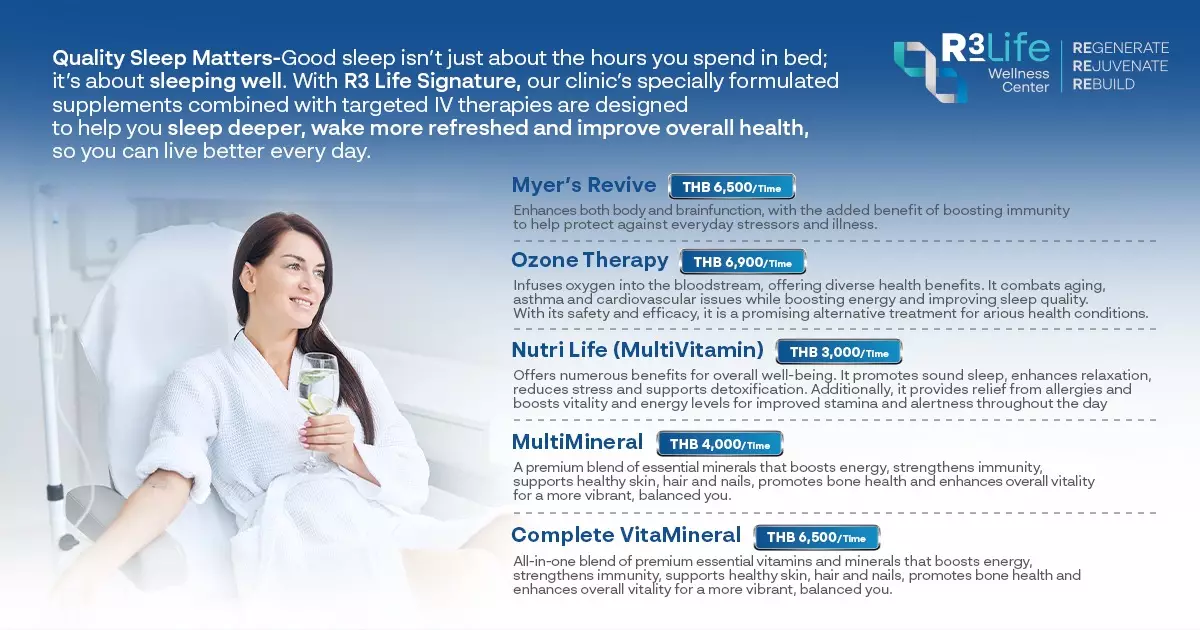
R3 Life offers two solutions to address insomnia problems for all patients:
Clinic Supplement
Many individuals begin with oral supplements for insomnia.
- Vital Sleep Clinic Supplement, helps with sleep and contains Magnesium, Pharma GABA, Vitamin B6, and other key ingredients supported by research to effectively promote sleep.
However, in cases of:
- Poor nutrient absorption
- High stress overload
- Chronic insomnia linked to autonomic imbalance
IV therapy
IV therapy for sleep support may be considered as an adjunctive strategy.
- NutriLife (Multivitamin IV) contains magnesium and B-complex to support nervous system balance.
- Ozone therapy may support oxygen utilization, antioxidant function, and autonomic stability, which can contribute to improved sleep quality in selected individuals.
IV therapy for sleep is not a direct insomnia cure. It is a supportive approach aimed at restoring physiological balance.
Frequently Asked Questions about How to Improve Sleep Quality
Q: How do I know if my insomnia is serious enough to see a doctor?
A: If you have difficulty falling asleep, frequent awakenings, or non-restorative sleep at least three nights a week for more than three months, this is considered chronic insomnia. A structured medical evaluation can help identify the root cause before long-term health risks accumulate.
Q: Can I improve sleep quality without medication?
A: Yes. Many cases respond well to non-pharmacological approaches such as CBT-I, consistent sleep-wake times, morning sunlight exposure, stress reduction, and nutritional support like magnesium and B-complex. These work best when matched to the specific cause of your sleep disruption.
Q: How long does it take to restore healthy sleep patterns?
A: Circadian rhythm adjustments can show noticeable changes within one to two weeks of consistent habits. Restoring deep sleep and full nervous system balance after chronic insomnia typically takes longer, and outcomes differ among individuals.
Conclusion: Insomnia Is Not a Minor Issue
Insomnia is not simply difficulty sleeping. It represents disruption of the body’s nightly repair mechanisms.
Research indicates:
- Chronic insomnia is associated with a 27–45% increased risk of cardiovascular disease (European Heart Journal, 2011).
- Sleeping fewer than 6 hours per night is associated with a 28% increased risk of type 2 diabetes (Sleep Meta-analysis, 2012).
- Chronic insomnia significantly increases the risk of depression, with some populations showing up to a twofold increase (JAMA Psychiatry, 2014).
These risks accumulate over years due to persistent deep sleep deficiency, circadian rhythm disruption, elevated cortisol, and impaired cellular repair.
The question is not whether you will sleep tonight.
The question is what chronic poor sleep quality may do to your health over the next 3 to 5 years.
Improving sleep quality, restoring deep sleep, and resetting circadian rhythm are long-term preventive strategies, not short-term comfort solutions.
If you experience chronic insomnia, frequent awakenings, or persistent fatigue despite adequate sleep duration, a structured medical evaluation may help identify the root cause before long-term health consequences develop.

 What Is Immunosenescence? Why Some People Recover Slowly Before They Are Old | R3 Life