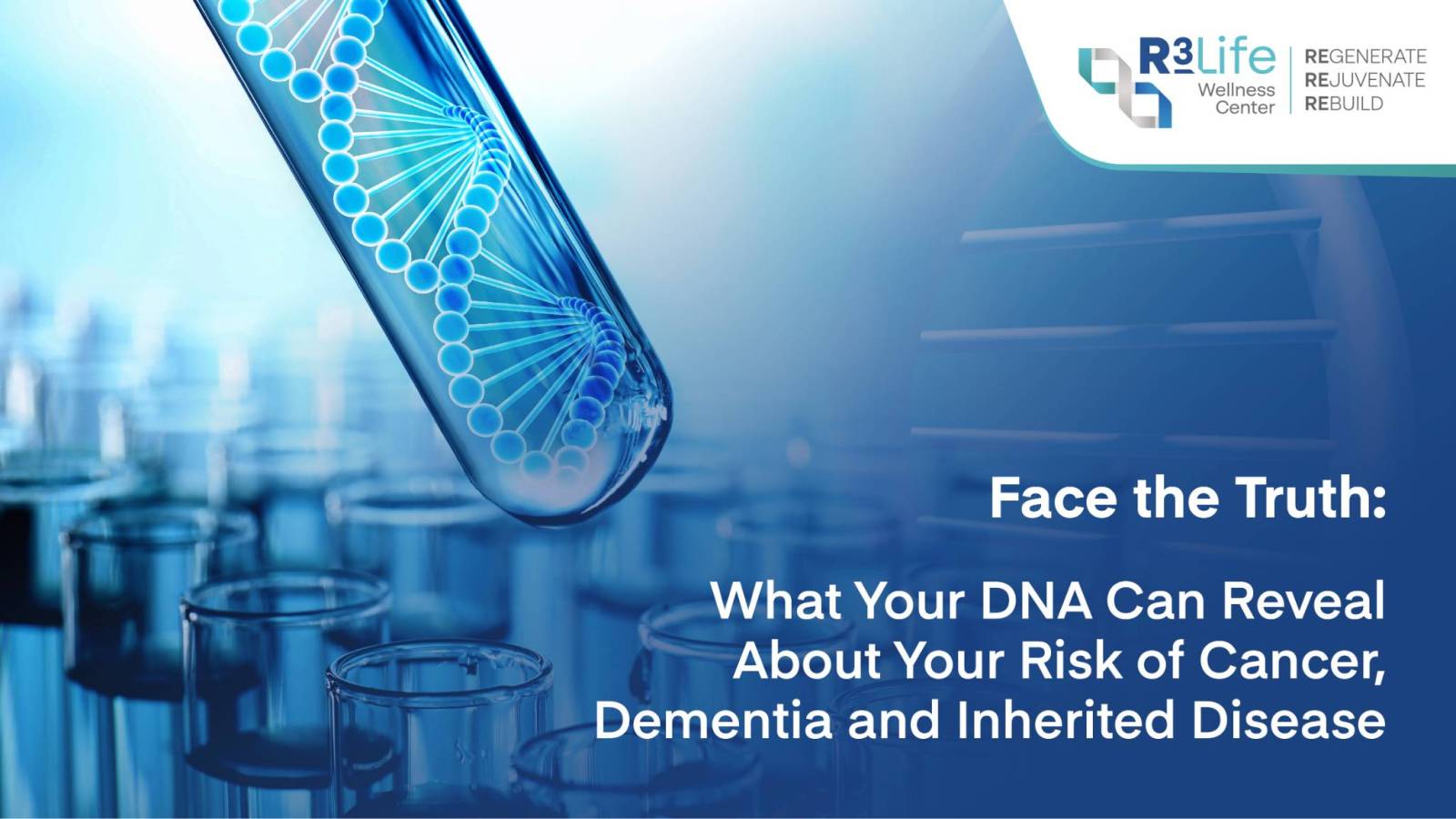
Face the Truth: What Your DNA Can Reveal About Your Risk of Cancer, Dementia and Inherited Disease
Worried about cancer or dementia in your family? A whole exome DNA test reveals inherited risk, with a physician-built plan at R3 Life Bangkok.
Face the Truth: What Your DNA Can Reveal About Your Risk of Cancer, Dementia and Inherited Disease
Key takeaways
- Family history misses a lot. In one large study, 82% of people carrying a high-risk BRCA1/2 variant didn't know it, and about half would not have qualified for testing based on their family history.
- The Premium DNA Health Profile uses Whole Exome Sequencing to look for inherited variants linked to 20+ types of cancer, dementia and brain conditions such as Alzheimer's and Parkinson's, and 60+ other health conditions.
- It also shows how your genes may affect your response to medications across 7 drug categories.
- Genetic risk is not a diagnosis. It's information you can act on, together with your doctor, while you still have time to plan.
- At R3 Life, a physician in anti-aging and regenerative medicine reviews every result with you and helps you decide on next steps.

The Question Most People Never Say Out Loud
"Will it happen to me too?"
Consider someone we'll call Mai. (She's a composite of the kind of client we often meet, not one real person.) Her mother was diagnosed with breast cancer at 52. Her grandfather spent his last years not recognizing his own children. Mai eats well, has an annual health check-up, and her blood tests always come back "normal."
But every time a relative gets sick, the same question comes back, usually late at night.
If this sounds familiar, you're not alone. And you don't have to keep living with a question that has an answer. Your DNA doesn't change over your lifetime, which means the information about your inherited risk is already there. You just haven't read it yet.
Face the truth. Dare to know yourself deeper.
Why Family History Only Tells Part of the Story
Most of us estimate our risk the same way: by looking at who got sick in the family. It's a reasonable starting point, but research shows it misses a surprising number of people.
- In a study of more than 50,000 adults who had their exomes sequenced, 82% of those carrying a high-risk BRCA1 or BRCA2 variant had never been tested, and among those with detailed family records, about half (49%) wouldn't have met the guidelines for testing at all. (Reference: Manickam et al., JAMA Network Open, 2018)
- In a study of nearly 3,000 cancer patients, universal genetic testing found an inherited cancer-related variant in 1 in 8 patients, and around half of those findings would have been missed by testing based on family history and standard criteria alone. (Reference: Samadder et al., JAMA Oncology, 2021)
Why does this happen? Families are small. Relatives die young of other causes. Some people don't know their family's full medical history, and some genetic risks come through the father's side, where conditions like ovarian cancer can't show up in male relatives.
In other words: a "clean" family history is not the same as a clean genetic profile.
Cancer Risk: Knowing What You Carry
It's important to be accurate here. According to the U.S. National Cancer Institute, inherited genetic variants play a major role in an estimated 5% to 10% of all cancers. (Reference: NCI, Genetic Testing for Inherited Cancer Risk) Most cancers are driven by aging, environment and lifestyle.
But for the people who do carry a high-risk variant, the difference can be dramatic.
| Inherited variant | Lifetime risk with the variant | General population |
| BRCA1/BRCA2: breast cancer (women) | More than 60% | About 13% |
| BRCA1: ovarian cancer | 39% to 58% | About 1.1% |
| BRCA2: ovarian cancer | 13% to 29% | About 1.1% |
(Reference: NCI, BRCA Gene Changes Fact Sheet, 2024)
BRCA is only one example. Other inherited conditions, such as Lynch syndrome (estimated to affect roughly 1 in 300 people), raise the risk of colorectal, uterine and other cancers.
Why knowing earlier matters
When a person knows they carry a high-risk variant, their doctor can offer options that aren't usually part of a standard check-up. According to the NCI, these can include earlier or more frequent screening (for example, breast MRI in addition to mammography) and discussing risk-reducing options. (Reference: NCI, BRCA Fact Sheet) Genetic information doesn't replace screening. It helps your doctor decide which screening, when, and how often.
What your report covers: Inherited cancer-related variants linked to 20+ cancer types, including breast, ovarian, colorectal, prostate, pancreatic, stomach, liver, lung, thyroid, uterine, kidney, bladder, skin (melanoma and non-melanoma) and leukaemia, with a clear "detected / not detected" result for each.

Dementia & Brain Health: The Risk People Fear Most
For many people, losing their memory feels more frightening than any other diagnosis. It's also a risk that runs quietly in families.
The most studied gene is APOE. About 1 in 4 people carries one copy of the APOE ε4 variant, which studies suggest raises the risk of Alzheimer's disease roughly two to three times. Carrying two copies (about 2% of people) is associated with a considerably higher risk. (Reference: U.S. National Institute on Aging) It's important to know that APOE ε4 is a risk factor, not a verdict: many carriers never develop Alzheimer's, and many people without it do.
Here's the part that gives this information its value. In 2024, the Lancet Commission on dementia concluded that up to 45% of dementia cases could potentially be prevented or delayed by addressing 14 modifiable risk factors, including high blood pressure, high LDL cholesterol, diabetes, physical inactivity, hearing loss, smoking, excess alcohol, social isolation and air pollution. (Reference: Livingston et al., The Lancet, 2024)
Your genes may load part of the risk. But many of the factors that matter most are ones you can work on, and knowing your genetic starting point can help you and your doctor decide how seriously and how early to act on them.
"But what if knowing makes me more anxious?”
It's a fair concern, and researchers have studied it. In the REVEAL study, published in the New England Journal of Medicine, adult children of people with Alzheimer's were randomly assigned either to learn their APOE result or not. Learning the result did not cause significant anxiety or depression compared with not knowing, and people who learned they did not carry ε4 experienced less distress. (Reference: Green et al., NEJM, 2009) Getting the result with proper guidance makes a real difference, which is why every R3 Life result is reviewed with a physician.
What your report covers: Genetic risk for Alzheimer's disease, frontotemporal dementia, Lewy body dementia and Parkinson's disease, plus selected brain and mental health conditions.
Common Health Risks and 60+ Inherited Conditions
Beyond cancer and dementia, the Premium DNA Health Profile looks at the conditions that most often affect long-term health and quality of life.
Common health risks: Heart disease, stroke, type 2 diabetes, high cholesterol, familial hypercholesterolemia (an inherited form of very high cholesterol), hypertension, non-alcoholic fatty liver disease and obesity.
Wider disease risk (60+ conditions), for example:
- Heart rhythm and heart muscle conditions: atrial fibrillation, long QT syndrome, Brugada syndrome, hypertrophic and dilated cardiomyopathy
- Blood vessel conditions: deep vein thrombosis, aortic aneurysm, peripheral artery disease
- Bone and joint conditions: osteoporosis, osteoarthritis, rheumatoid arthritis
- Eye health: glaucoma, age-related macular degeneration
- Metabolic, autoimmune and other conditions: insulin resistance, hypothyroidism, gout, psoriasis, Crohn's disease, ulcerative colitis, and more
Many of these conditions develop silently for years. Knowing where your genetic risk is higher helps your doctor tailor your regular check-ups, so the tests you do each year are the ones that matter most for you.
A Bonus Layer: How Your Genes Affect Your Medications
Most people assume a standard dose works the same way for everyone. It doesn't.
Your genes influence how quickly your body breaks down many common medications. Some people are "poor metabolizers" who may build up too much of a drug at a normal dose. Others are "ultrarapid metabolizers" who may clear it before it can work.
This isn't rare. In a program that tested more than 9,500 patients, 91% carried at least one genetic variant that could affect how a medication should be prescribed. (Reference: Van Driest et al., Clinical Pharmacology & Therapeutics, 2014)
It's especially relevant in Asia:
- About 14% of Chinese people are CYP2C19 "poor metabolizers," compared with about 2% of Caucasians. This gene affects how well the common heart medication clopidogrel works. (Reference: NCBI Medical Genetics Summaries)
- In a Thai study, people carrying the HLA-B*15:02 gene variant had about 55 times higher odds of a severe skin reaction to the anti-seizure drug carbamazepine. (Reference: Tassaneeyakul et al., Epilepsia, 2010)
A large European trial found that using a genetic panel to guide prescriptions was associated with about 30% fewer clinically relevant side effects. (Reference: Swen et al., The Lancet, 2023)
What your report covers: How your genes may affect your response to medications in 7 categories: cardiovascular, diabetes, pain, psychiatric, commonly prescribed drugs, and drugs used in children and older adults. You can share these results with any doctor who prescribes for you, now or in the future.

Why Whole Exome Sequencing
Many consumer DNA kits check a pre-selected list of genetic "spots," a bit like reading only the highlighted words in a book. For disease risk, that approach can miss a lot, because harmful variants can appear anywhere within a gene.
The Premium DNA Health Profile uses Whole Exome Sequencing (WES), which reads the exome in full. The exome makes up only around 1% to 2% of your DNA, but it contains your protein-coding genes, which is where many of the known disease-related variants are found. Reading it completely gives a far more thorough look at inherited risk than spot-checking alone.
At a glance:
- Sample: a painless cheek (buccal) swab, no needles, no blood
- Analysis: Whole Exome Sequencing at an internationally accredited laboratory
- Results: in about 45 days, accessible through a secure mobile app
- Data security: protected according to ISO/IEC 27001, the international standard for information security
- One test, for life: your DNA doesn't change, so your results stay relevant as you age
Knowing Is Not a Diagnosis. It's a Head Start.
It's important to be clear about what a genetic risk result means.
- An "elevated risk" result does not mean you have, or will develop, a disease.
- A "not detected" result does not mean you're risk-free. Lifestyle, environment and age still matter, and recommended screening should continue.
- Some significant findings, such as a high-risk cancer variant, should be confirmed with clinical-grade testing and discussed with a genetic specialist before any medical decisions are made.
That's why the Premium DNA Health Profile at R3 Life doesn't end with a report. Your results are reviewed with a physician specializing in anti-aging and regenerative medicine, who will:
- Explain what each important finding means for you, in plain language
- Help you prioritize which risks deserve attention now and which are simply worth monitoring
- Recommend a personalized plan for screening, check-ups, lifestyle and prevention of modifiable risk factors
- Advise whether confirmatory testing or referral to a specialist is recommended
- Discuss what your results may mean for family members who share your genes
Worrying doesn't change your risk. Knowing lets you plan for it.
How It Works
- Book your consultation at R3 Life, Bangkok, via WhatsApp +66 88 689 8888.
- Take a gentle cheek swab. No needles, no blood draw, done in minutes. (Avoid eating, drinking, smoking, chewing gum or brushing your teeth shortly before the swab.)
- Whole Exome Sequencing at an internationally accredited laboratory.
- Receive your report in about 45 days, with 500+ insights across 20+ categories.
- Sit down with your R3 Life physician to understand your results and build your personalized plan.
Who This Test Is For
The Premium DNA Health Profile may be right for you if you:
- Have a parent, sibling or grandparent who had cancer, dementia, heart disease or stroke
- Don't know much about your family's medical history
- Have a "normal" annual check-up but still want to understand your long-term risks
- Want to know which screenings and check-ups deserve the most attention for you
- Are planning a family and want to understand what you might pass on
- Take regular medication, or expect to, and want to know how your body may respond
- Prefer to face the facts and plan ahead rather than wonder
Frequently Asked Questions
1. Can a DNA test tell me if I will get cancer?
No. It can show whether you carry inherited variants that are linked to a higher risk of certain cancers. Most cancers are not inherited, and carrying a variant does not mean you will definitely develop cancer. Your physician will explain what your result means for you.
2. If my result shows no high-risk variants, can I skip regular screening?
No. A "not detected" result lowers the chance that you carry the specific inherited variants tested, but it does not remove risk from age, lifestyle or environment. Continue the screening your doctor recommends.
3. What is the difference between this test and my annual health check-up?
A health check-up measures what's happening in your body right now. A DNA test shows your inherited tendencies, which don't change. The two work best together: your genetic results help your doctor decide which check-ups matter most for you.
4. Does carrying APOE ε4 mean I will get Alzheimer's disease?
No. APOE ε4 increases risk, but many carriers never develop Alzheimer's. Research suggests that addressing modifiable risk factors such as blood pressure, cholesterol, physical activity and hearing may help reduce or delay dementia risk overall.
5. What happens if a serious risk is found?
Your R3 Life physician will explain the result, advise whether confirmatory clinical testing or referral to a specialist is recommended, and help you plan the right screening and next steps.
6. Should I tell my family about my results?
It's your choice. Because relatives may share the same variants, some people find it helpful to share significant findings so family members can speak with their own doctors. Your physician can help you think this through.
7. What is Whole Exome Sequencing (WES)?
WES reads the protein-coding regions of your genes (the exome) in full, rather than checking only pre-selected genetic markers. This gives a more thorough view of inherited variants linked to disease risk.
8. Is the test painful? How long do results take?
It's a painless cheek swab. Results are ready in about 45 days after your sample reaches the laboratory.
9. Is my genetic data kept private and secure?
Yes. Your genetic data is stored and protected according to ISO/IEC 27001, the leading international standard for information security management.
10. Where can I take a genetic disease risk test in Bangkok?
The Premium DNA Health Profile is available at R3 Life Wellness Center in Bangkok, with physician-led interpretation and a personalized plan included. Book via WhatsApp +66 88 689 8888.
Face the Truth. Plan Ahead.
The question "Will it happen to me?" doesn't go away by avoiding it. Your genetic information has been with you since the day you were born. The only choice is whether you read it and use it, or keep wondering.
Stop guessing. Start knowing.
👉 Book your Premium DNA Health Profile at R3 Life via WhatsApp +66 88 689 8888
This article is for educational purposes and does not replace medical advice. Genetic test results describe inherited predispositions and do not diagnose, treat or prevent any disease. Significant findings may require confirmatory clinical testing. Always consult a qualified physician before making medical decisions or changing any medication.
References
- Manickam K, et al. Exome sequencing-based screening for BRCA1/2 expected pathogenic variants among adult biobank participants. JAMA Network Open. 2018;1(5):e182140. https://pubmed.ncbi.nlm.nih.gov/30646163/
- Samadder NJ, et al. Comparison of universal genetic testing vs guideline-directed targeted testing for patients with hereditary cancer syndrome. JAMA Oncology. 2021;7(2):230-237. https://pubmed.ncbi.nlm.nih.gov/33126242/
- National Cancer Institute. Genetic Testing for Inherited Cancer Risk. https://www.cancer.gov/about-cancer/causes-prevention/genetics/genetic-testing-fact-sheet
- National Cancer Institute. BRCA Gene Changes: Cancer Risk and Genetic Testing Fact Sheet. 2024. https://www.cancer.gov/about-cancer/causes-prevention/genetics/brca-fact-sheet
- National Institute on Aging. Study reveals how APOE4 gene may increase risk for dementia. https://www.nia.nih.gov/news/study-reveals-how-apoe4-gene-may-increase-risk-dementia
- Livingston G, et al. Dementia prevention, intervention, and care: 2024 report of the Lancet standing Commission. The Lancet. 2024. https://www.thelancet.com/commissions-do/dementia-prevention-intervention-and-care
- Green RC, et al. Disclosure of APOE genotype for risk of Alzheimer's disease. N Engl J Med. 2009;361(3):245-254. https://www.nejm.org/doi/abs/10.1056/NEJMoa0809578
- Van Driest SL, et al. Clinically actionable genotypes among 10,000 patients with preemptive pharmacogenomic testing. Clin Pharmacol Ther. 2014;95(4):423-431. https://pubmed.ncbi.nlm.nih.gov/24253661/
- Dean L. Clopidogrel therapy and CYP2C19 genotype. Medical Genetics Summaries, NCBI. https://www.ncbi.nlm.nih.gov/books/NBK84114/
- Tassaneeyakul W, et al. Association between HLA-B*1502 and carbamazepine-induced severe cutaneous adverse drug reactions in a Thai population. Epilepsia. 2010;51(5):926-930. https://pubmed.ncbi.nlm.nih.gov/20345939/
- Swen JJ, et al. A 12-gene pharmacogenetic panel to prevent adverse drug reactions: an open-label, multicentre, controlled, cluster-randomised crossover implementation study. The Lancet. 2023;401(10374):347-356. https://www.thelancet.com/journals/lancet/article/PIIS0140-6736(22)01841-4/abstract
 GLP-1 Weight Loss: Why the Future of Weight Management Is About Metabolic Wellness, Not Starvation