
Psoriatic Arthritis and What Stem Cell Research Shows
Key Highlights
- Psoriatic arthritis is a long-term inflammatory condition that affects the joints and often, but not always, occurs alongside the skin condition psoriasis.
- Common psoriatic arthritis symptoms include joint pain and swelling, morning stiffness, swollen fingers or toes, heel pain, and nail changes.
- Standard treatments, including disease-modifying drugs and biologics, remain first-line and help many people control symptoms and protect their joints.
- Mesenchymal stem cells are being studied for their potential to help regulate the overactive immune responses that drive inflammatory joint disease.
- Stem cell therapy can be considered as a complementary approach, working alongside ongoing rheumatologic care.
Quick Summary
Psoriatic arthritis is managed over the long term, and many people spend years adjusting treatments to find what works. For those who have tried several options, it is natural to look further, and mesenchymal stem cells are one area attracting attention.
The research has genuine scientific logic behind it. This article explains what psoriatic arthritis is, why researchers are interested in stem cells in this context, and what the research shows so far.
Understanding Psoriatic Arthritis
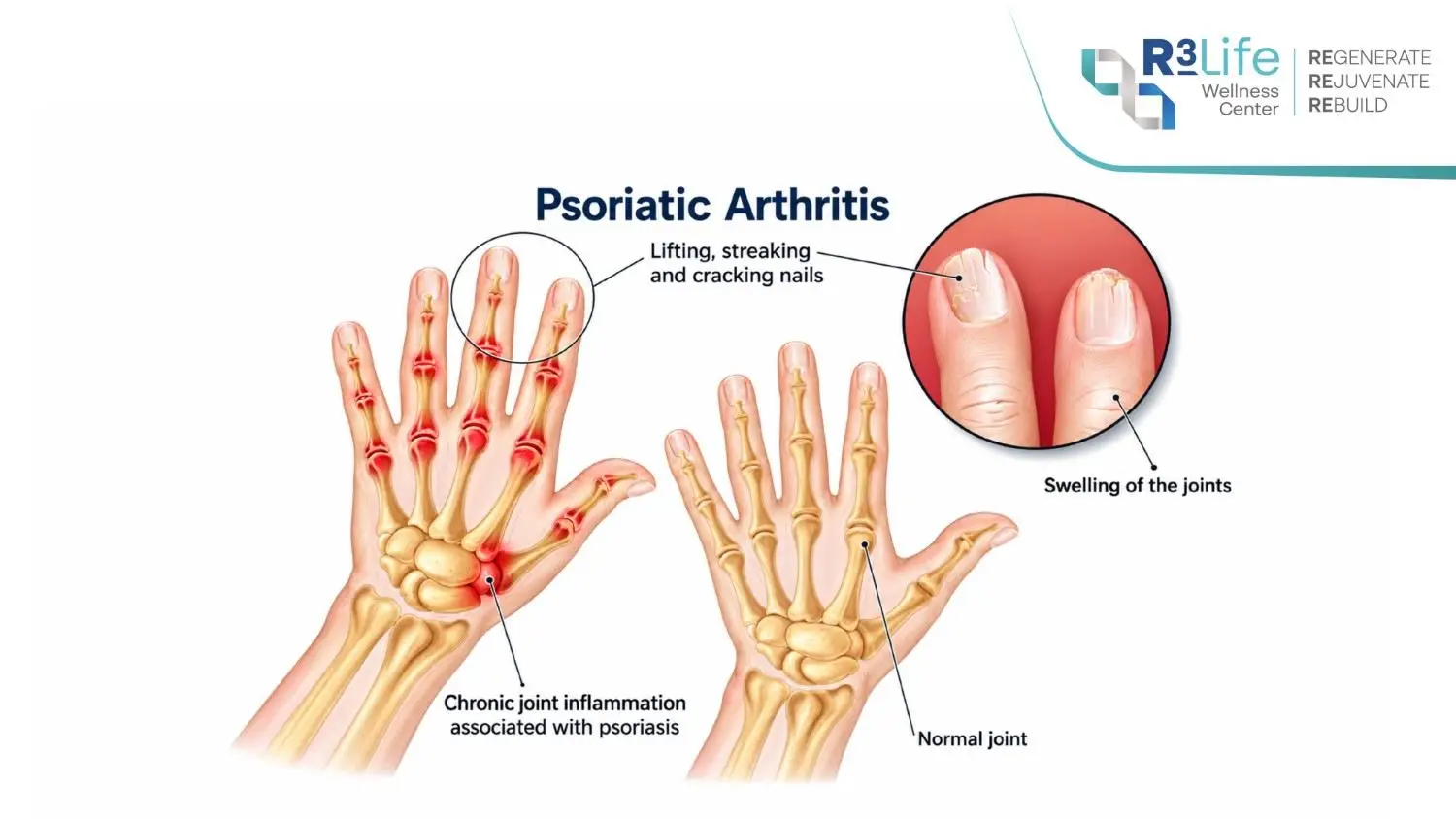
Psoriatic arthritis is an inflammatory arthritis linked to psoriasis. It can affect joints, tendons, and the points where tendons attach to bone.
How It Differs From Psoriasis Alone
Psoriasis is an immune-driven skin condition. Some people with psoriasis go on to develop psoriatic arthritis, in which the same immune activity also targets the joints and surrounding tissues. Common psoriatic arthritis symptoms include:
- Joint pain, swelling, and stiffness, often worse in the morning
- Swelling of a whole finger or toe, known as dactylitis
- Pain where tendons attach to bone, such as the heel
- Nail changes, including pitting or separation from the nail bed
- Fatigue and, in some people, lower back pain
Because it involves the joints, it usually needs rheumatology care alongside skin care.

Why Joint Symptoms Sometimes Appear First
In most people, skin psoriasis appears before joint symptoms. In a minority, the joints are affected first, or skin changes are mild enough to go unnoticed. This can delay diagnosis, which matters because early treatment helps protect joints from lasting damage.
The Immune Mechanisms Involved
Psoriatic arthritis involves overactive immune signaling, including pathways driven by proteins such as TNF, IL-17, and IL-23. Many modern treatments target these pathways directly, which is part of why outcomes for people with the condition have improved considerably.
Why Researchers Are Studying MSCs Here
Mesenchymal stem cells (MSCs) are studied in many inflammatory conditions because of the way they interact with the immune system.
Immunomodulation and the Secretome
MSCs release a wide range of signaling molecules, collectively known as the secretome. In laboratory studies, these signals can dampen overactive immune responses and encourage more regulatory immune activity. Researchers believe this signaling, rather than cells replacing tissue, is the main way MSCs may exert their effects.
What Preclinical Work Has Shown
In animal models of inflammatory arthritis and psoriasis-like disease, MSC therapy has been associated with reduced inflammation and improved disease markers. These findings provide a clear scientific rationale for studying MSCs in people.
What Clinical Studies Report
Human studies of MSCs in immune-driven conditions, including psoriasis and rheumatoid arthritis, have reported favorable safety and signs of symptom improvement. Research specific to psoriatic arthritis is a growing area of interest.
Where Stem Cell Therapy Fits in Care
Understanding how stem cell therapy sits alongside established treatment helps set clear expectations.
Why Psoriatic Arthritis Is Managed Long Term
Psoriatic arthritis is a chronic condition, so care focuses on controlling inflammation, relieving symptoms, and protecting the joints over time.
Where Standard Care Remains First-Line
Standard psoriatic arthritis treatment, including disease-modifying drugs, biologics, and targeted therapies, has strong evidence behind it and helps many people achieve good control. It remains the foundation of care, guided by a rheumatologist. Stopping or changing medication without medical advice can lead to flares.
Where the Research Is Heading
Researchers are now running larger trials, refining cell sources and dosing, and following patients over longer periods. As this work progresses, the role of MSCs in inflammatory joint conditions continues to take shape.
Still Having Symptoms Despite Treatment?
Living with psoriatic arthritis that has not settled is exhausting, and it is a common experience rather than a sign that you have run out of options. Several things are worth raising at your next appointment.
Questions Worth Raising With a Rheumatologist
Before considering any additional therapy, it helps to discuss:
- How well your current treatment is controlling inflammation
- Whether adjustments to standard care are still available
- How an additional therapy might interact with your current medications
Your rheumatologist remains central to your care, whatever else you consider.
What Else May Be Contributing
Not every remaining symptom comes from joint inflammation alone. Poor sleep, high stress, weight, and other health conditions can all influence how you feel day to day, and fatigue in particular often has more than one cause. Blood-based screening can look at inflammatory markers, vitamin D, thyroid function, and metabolic markers that may be shaping the wider picture. These tests do not treat psoriatic arthritis, but they can highlight factors worth addressing alongside your current care.
Where Regenerative Options Sit
At R3 Life Wellness Center, Stem Cell Therapy using Cord Tissue-MSCs or Amnion-MSCs may be considered as a complementary option for suitable individuals, alongside ongoing rheumatologic care. The aim is to support the body's own regulation of inflammation, working alongside the treatment you already rely on.
Cells are sourced through R3 Life's partner cell bank, processed under Class 100 clean room standards, and checked for viability before use. Every patient first completes a Pre-Stem Cell Blood Test and physician assessment, and outcomes differ among individuals.
Frequently Asked Questions About Psoriatic Arthritis
Q: Can stem cell therapy replace my psoriatic arthritis medication?
A: No. Stem cell therapy is designed to work alongside your existing medication, not replace it, and your rheumatologist stays involved throughout.
Q: How do I know if my joint pain is psoriatic arthritis?
A: Psoriatic arthritis symptoms can resemble other types of arthritis, so diagnosis requires a physician's assessment, usually by a rheumatologist. Useful clues include psoriasis or a family history of it, swollen fingers or toes, heel pain, and nail changes.
Q: How soon would I notice a change after stem cell therapy?
A: Because MSCs are thought to act by influencing immune signaling, any changes are more likely to develop gradually than immediately.
Q: What happens during an assessment for stem cell therapy?
A: At R3 Life, an assessment typically includes a review of your diagnosis and current treatment, a Pre-Stem Cell Blood Test, and a discussion of realistic expectations. If stem cell therapy is not a suitable fit, the physician will tell you so.
Conclusion
Psoriatic arthritis is a chronic condition that modern treatments can control well for many people. Mesenchymal stem cells offer a promising complementary approach with a clear scientific rationale, and research in this area continues to grow.
Care at R3 Life Wellness Center is led by a physician board-certified in anti-aging and regenerative medicine (ABAARM) and certified in cell therapy. To discuss whether a complementary approach may suit your situation, contact R3 Life at r3lifewellness.com or via WhatsApp at +66 88 689 8888.
 How do stem cells from the umbilical cord and placenta help restore the body better than other types?