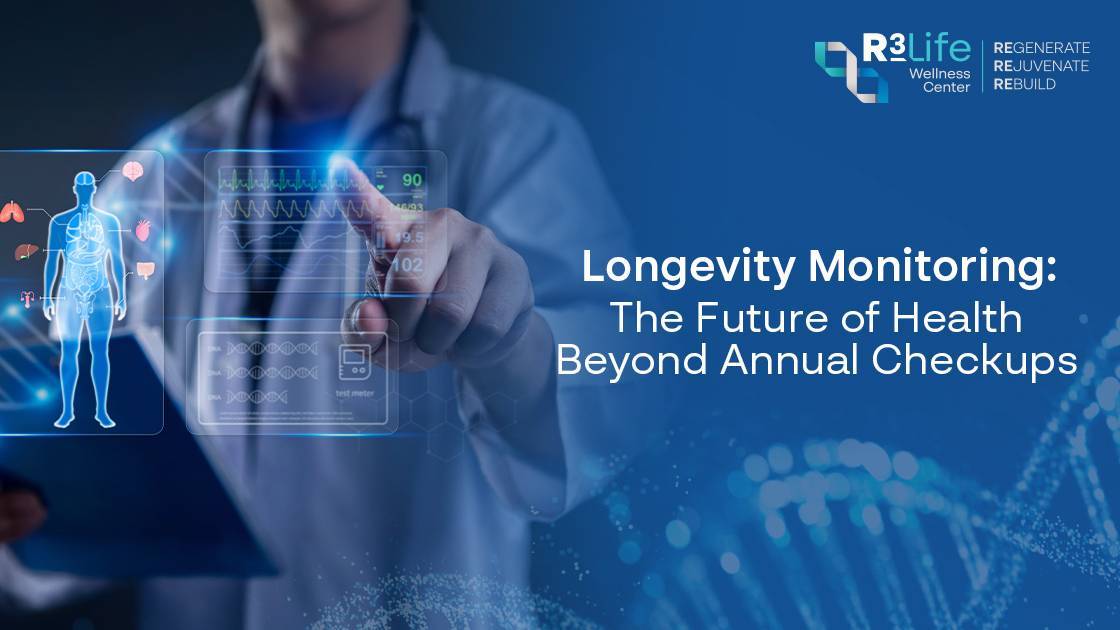
Longevity Monitoring: The Future of Health Beyond Annual Checkups
Key Takeaways: Why Health Should Be Monitored Beyond Annual Checkups
- Health is not something to check once a year, but a system that constantly changes
- Continuous Longevity Monitoring uses technology to track your health over time
- Blood biomarkers reveal trends in your health before disease develops
- AI enables more accurate prediction of future health risks
- Proper interpretation requires certified medical professionals for personalized care
It’s not just about knowing whether you are “normal” it’s about understanding where your health is heading
Longevity Technology: When Health Is No Longer Measured Once a Year
For decades, health care has been defined by a simple routine: the annual checkup.
You visit a hospital, run a few tests, and leave with results labeled “normal.”But biologically, the human body is never static.
Blood sugar fluctuates. Hormones shift. Inflammation develops quietly. Metabolic processes evolve continuously.
Relying on a once-a-year check is like taking a single photograph of a river — and assuming you understand its flow for the entire year.
In recent years, the field of Longevity Medicine has begun to challenge this model.
Health is no longer viewed as a one-time result but as a continuous stream of data a Living Data Stream
And this is where a new concept emerges:
Continuous Longevity Monitoring
What Is Continuous Longevity Monitoring and Why It Matters
Continuous Longevity Monitoring is the use of technology to track your health over time, rather than relying on a single annual snapshot.
It represents a shift from:
“Wait until something goes wrong”
to
“Detect subtle signals before problems develop”
This approach integrates:
- Advanced biomarker testing
- Biosensor and wearable technologies
- Preventive and personalized medicine
Research published in journals such as Nature Medicine and The Lancet Healthy Longevity shows that metabolic changes and chronic inflammation can begin years before disease symptoms appear
The real question is:
If we can detect these signals early, can we change the future of our health?

Biomarkers: The Hidden Language of Your Body
Beneath the surface, your body is constantly generating data.
This data is reflected through biomarkers measurable indicators of internal processes, including:
- Inflammation levels
- Metabolic function
- Hormonal balance
- Cellular stress
In longevity medicine, biomarkers are not only used for diagnosis but for understanding long-term health trends
This is why testing is often recommended every 3–6 months Because what matters most is not just whether a value is “normal” but how it is changing over time
A blood glucose level may still fall within the normal range but if it is steadily increasing, it may indicate early insulin resistance
Similarly, a slight rise in hs-CRP may signal low-grade chronic inflammation long before cardiovascular disease develops
Health is not defined by a single number but by the story multiple biomarkers tell together

AI, Digital Twin, and the Future of Predictive Health
The power of longevity monitoring lies not only in collecting data
but in understanding it.
Today, technologies such as Artificial Intelligence (AI) can analyze health data from multiple sources simultaneously, including:
- Blood biomarkers
- Wearable devices
- Sleep patterns
- Physical activity
AI can identify patterns that are often invisible to the human eye
and estimate future health risks before abnormalities appear
Another emerging concept is Digital Twin Health a virtual model of your body built from real health data
This model can simulate how your health may evolve over time, such as:
- How weight loss affects metabolic risk
- How sleep patterns influence long-term health
At the same time, wearable technologies provide biofeedback, allowing your body to “communicate” in real time
Poor sleep → reduced recovery
Certain foods → glucose spikes
Health is no longer something we guess but something we can observe, measure, and learn from

Longevity Monitoring Requires Clinical Validation
Despite rapid technological advancement, data alone is not enough.
Health data must be interpreted within a clinical context
A single biomarker may appear normal in isolation but when analyzed alongside other markers such as insulin, triglycerides, and inflammatory indicators it may reveal early signs of metabolic dysfunction
This is often the starting point of conditions like diabetes or cardiovascular disease
Effective longevity monitoring therefore requires:
- Appropriate biomarker testing
- Multi-dimensional data analysis
- Expert clinical interpretation
At R3 Life Wellness Center, health data is analyzed and translated into personalized care plans under the supervision of physicians certified by the ABAARM (American Board of Anti-Aging and Regenerative Medicine)
This ensures that your data is not just collected but transformed into actionable, medically grounded strategies
The Future of Health Is Not Reactive — It Is Predictive
Longevity technology is redefining how we approach health
From annual checkups
→ to continuous monitoring
From treating disease
→ to predicting and preventing it
In the future, health may no longer be something you check once a year
But something you understand, track, and optimize continuously
Because true longevity is not only about living longer but about maintaining quality of life throughout your years
FAQ: Common Questions About Longevity Monitoring
1. What is Continuous Longevity Monitoring and how is it different from regular checkups?
Continuous Longevity Monitoring is an approach that tracks your health over time using technologies such as blood biomarkers, wearable devices, and AI. Unlike traditional annual checkups, which provide a snapshot, this method focuses on identifying trends and detecting risks early before symptoms appear.
2. How often should I test blood biomarkers?
In longevity medicine, blood biomarkers are typically tested every 3–6 months. This allows physicians to track changes over time, particularly in metabolism, inflammation, and hormonal balance, and adjust personalized health strategies accordingly.
3. How does Longevity Monitoring start at R3 Life Wellness Center?
If you already have biomarker data, you can share it with our medical team to help design a truly personalized, comprehensive care program tailored to your needs.
We also offer a wide range of blood testing programs to provide deeper health insights and enable more precise planning.
For those interested in vitamin support, we provide over 40 IV drip formulations addressing various health concerns, as well as personalized oral supplement plans designed specifically for your body and goals.

 Is Health Really Wealth? R3 Life Wellness Invites You to Invest in Your Health “Smartly”