Ozone Therapy for Immunity & Inflammation Compare with HBOT & EBOO
Summary
Ozone Therapy IV is a form of cellular-level restoration. It is not simply about increasing oxygen, but enhancing the body’s ability to utilize oxygen more efficiently. It helps support the immune system, reduce inflammation, and improve overall energy levels by activating internal systems such as white blood cells, cytokines, and antioxidant pathways. It is clearly different from HBOT and EBOO in terms of mechanism. Ozone IV focuses on “how the body actually uses” oxygen rather than increasing quantity or procedural complexity. It is a simple yet biologically aligned approach. It does not involve pressure (like HBOT) or extracorporeal blood circulation (like EBOO). It is suitable for preventive care and long-term health optimization, and should be performed under medical supervision to ensure it is tailored to each individual.
What is Ozone Therapy IV? Cellular Restoration Through a Mechanism the Body Understands
Today, healthcare is no longer limited to treating illness. It is evolving toward Preventive and Regenerative Medicine, focusing on restoring and rebalancing the body from within. The key question is no longer just what we add to the body, but how effectively the body can use it.
What is Ozone Therapy IV?
Ozone Therapy IV (Autohemotherapy) involves drawing approximately 200 ml of the patient’s blood, mixing it with ozone gas (O₃) in a closed system, and reinfusing it back into the body.
When ozone reacts with components in the blood, it generates active molecules that help stimulate various biological systems.
The core concept is not simply to “add” oxygen into the body,
but to activate the body’s own cellular response mechanisms.
Ozone therapy works by inducing a controlled level of mild oxidative stress, which may stimulate the body’s natural defense systems (antioxidant defense system) and support several key processes, such as:
- Activation of the body’s antioxidant defense system
- Support of mitochondrial function related to cellular energy production
- Modulation of immune system balance
- Support of metabolic signaling related to cellular stress response
Therefore, the approach is not just about supplementation,
but about restoring balance and improving the body’s functional efficiency.
Deep Cellular-Level Restoration
Ozone Therapy IV is used in regenerative medicine to support the body across multiple functions.
It may help strengthen the immune system by stimulating white blood cells and cytokine production such as interferons and interleukins.
It may enhance oxygen utilization by improving oxygen release from red blood cells, allowing tissues and organs to receive adequate oxygen.
It may also help reduce chronic inflammation by modulating inflammatory mediators such as TNF-α, and support antioxidant systems through key enzymes like SOD, catalase, and glutathione.
It is suitable for individuals who want to “optimize” their health, not just recover from symptoms:
- Individuals with weakened immunity or frequent illness
- Those experiencing slow recovery
- Individuals with chronic inflammatory conditions such as allergies
- Those with fatigue or low energy levels
What are HBOT and EBOO?
Among oxygen-related therapies, two other commonly discussed approaches include:
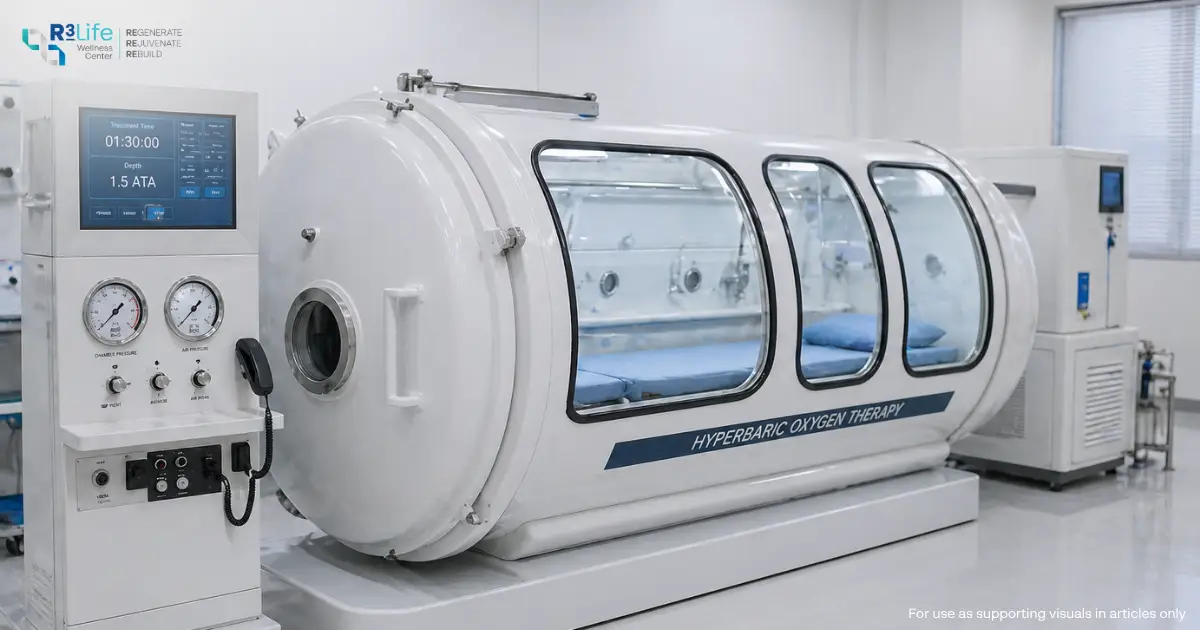
HBOT (Hyperbaric Oxygen Therapy)
HBOT involves breathing pure oxygen in a high-pressure chamber.
While it increases oxygen levels in the blood, the process directly involves pressure and the respiratory system, meaning oxygen must still pass through lung exchange before being delivered to cells.
The primary mechanism is increasing oxygen supply to tissues, which may support healing processes such as reducing inflammation, swelling, and improving wound repair.
It is commonly used in medical contexts such as post-surgical care, chronic wounds, or oxygen-deficient conditions.
However, because it involves pressure changes, patients must remain in a pressurized chamber for a period of time, and some may experience discomfort such as ear pressure or a confined-space sensation, similar to airplane takeoff or landing.
Thus, HBOT focuses on increasing oxygen delivery through pressure and respiratory mechanisms under professional supervision.
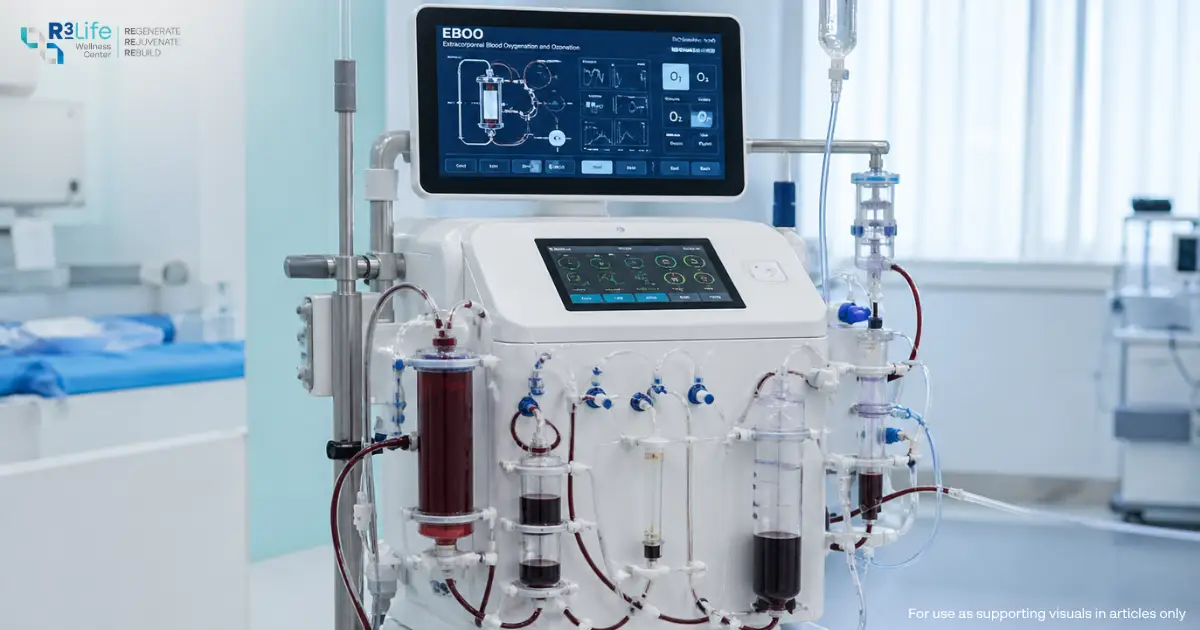
EBOO (Extracorporeal Blood Oxygenation and Ozonation)
EBOO is a more complex method where blood is circulated خارج the body through a machine, exposed to oxygen and ozone, and then returned.
This process resembles extracorporeal circulation techniques, similar to certain blood purification procedures.
Conceptually, EBOO combines ozone therapy with partial blood filtration.
However, its ability to remove substances from the blood may not be equivalent to dedicated filtration techniques such as DFPP (Double Filtration Plasmapheresis).
Because of this, treatment choice depends on the objective.
If the goal is stimulation of the body’s response via ozone, standard ozone therapy may be simpler and more comfortable.
EBOO, on the other hand, is more complex, requiring external blood circulation and typically two vascular access points, similar to plasmapheresis procedures.
Key Differences
Although all three methods involve oxygen, their mechanisms are fundamentally different:
- HBOT → Increases oxygen levels through pressure in a controlled chamber
- EBOO → Circulates blood outside the body for oxygenation and ozonation with partial filtration
- Ozone Therapy IV → Uses ozone to stimulate biochemical processes, enhancing the body’s ability to utilize oxygen efficiently

Choose What the Body Can Truly Use
In practice, increasing oxygen does not always mean the body can use it effectively.
The body must go through three steps:
exchange → transport → cellular utilization
Therefore, what matters more than quantity is efficiency of use.
True restoration is not about giving more,
and not every oxygen-increasing method leads to better outcomes.
Ozone Therapy IV offers an approach aligned with the body’s natural mechanisms,
focusing on sustainable balance rather than temporary effects.
FAQ
Is Ozone Therapy IV safe?
A: It is generally considered safe when performed under the supervision of experienced medical professionals using certified medical equipment. Patients should always disclose their medical history and undergo proper evaluation.
What does it feel like? Is it painful?
A: The procedure is similar to a standard IV infusion. There may be slight discomfort at the injection site, but overall it is well tolerated. Some individuals report feeling relaxed, refreshed, or more energized afterward. It may also support better sleep quality.
How many sessions are needed?
A: Results vary by individual. Some may notice changes after the first session, but typically 3–4 sessions are recommended for optimal balance.
Can it be combined with vitamin IV therapy?
A: Yes, it is often combined with vitamin IV therapy. Once oxygen utilization improves, nutrient absorption may also be enhanced. However, this should always be guided by a physician.
How is it different from EBOO?
A: In terms of outcomes, they may appear similar. However, from a mechanistic perspective, Ozone Therapy IV alone is often sufficient to stimulate mild oxidative stress and activate the body’s defense systems, with a simpler and more comfortable process.
EBOO is more complex, involving extracorporeal circulation and additional technical steps.
For cases requiring removal of specific blood components, such as certain autoimmune conditions, physicians may consider specialized filtration methods like DFPP, which are designed specifically for that purpose.
Ultimately, the choice of therapy depends on treatment goals, health conditions, and professional medical guidance.

 Why Some People Age Slower: Genetics, Lifestyle, and Science