Stem Cell Therapy for Diabetes: What Research Shows
Key Highlights
- Type 2 diabetes can enter remission, meaning normal blood sugar without medication, but doctors do not currently consider it fully curable.
- Remission is defined as an HbA1c below 6.5% sustained for at least three months without glucose-lowering medication.
- Significant weight loss early after diagnosis is the most proven route to type 2 diabetes remission in clinical trials.
- Stem cell therapy for diabetes remains investigational, with early studies showing modest, preliminary improvements rather than a cure.
- The recent "insulin-free" stem cell results reported in the news involve type 1 diabetes and a different cell-replacement technique.
Quick Summary
If you or someone close to you lives with type 2 diabetes, you have probably wondered whether the condition is permanent. It is one of the most searched health questions in the world, and the honest answer is more encouraging than it used to be, though it comes with important nuance.
Research over the past decade has shown that type 2 diabetes is not always a one-way street. In the right circumstances, blood sugar can return to a healthy range without medication. At the same time, regenerative medicine, including stem cell therapy for diabetes, is being studied as a way to support metabolic health.
Understanding what is proven, what is promising, and what is still experimental helps you make calm, informed decisions. Here is what the current science actually says, explained in plain language.
What Actually Happens in the Body With Type 2 Diabetes
To understand whether diabetes can be reversed, it helps to know what goes wrong in the first place.
Insulin Resistance, the Core Mechanism
Insulin is a hormone your pancreas releases after you eat, and its job is to move sugar, known as glucose, out of your bloodstream and into your cells for energy. Think of it as a key that unlocks each cell so sugar can get inside. In type 2 diabetes, the locks gradually stop responding to the key, a problem called insulin resistance, and the pancreas compensates by producing more and more insulin to force those doors open.
For a while this works and blood sugar stays normal, but over time the pancreas cannot keep up, the insulin-producing cells become strained, and blood sugar begins to rise. That rise is what a diabetes diagnosis measures. Many people with type 2 diabetes also carry a low, ongoing level of inflammation that makes the problem harder to unwind, and these two threads, resistance and inflammation, become important later when we look at newer therapies.
Why Conventional Management Has Its Limits
Standard care for type 2 diabetes is genuinely effective at controlling blood sugar. It usually pairs lifestyle guidance with medications that lower glucose or help the body use insulin more efficiently.
These tools manage the condition well, but they are largely designed to control it rather than resolve the underlying resistance and inflammation. That is why researchers keep searching for approaches that address the root causes, not only the symptoms.
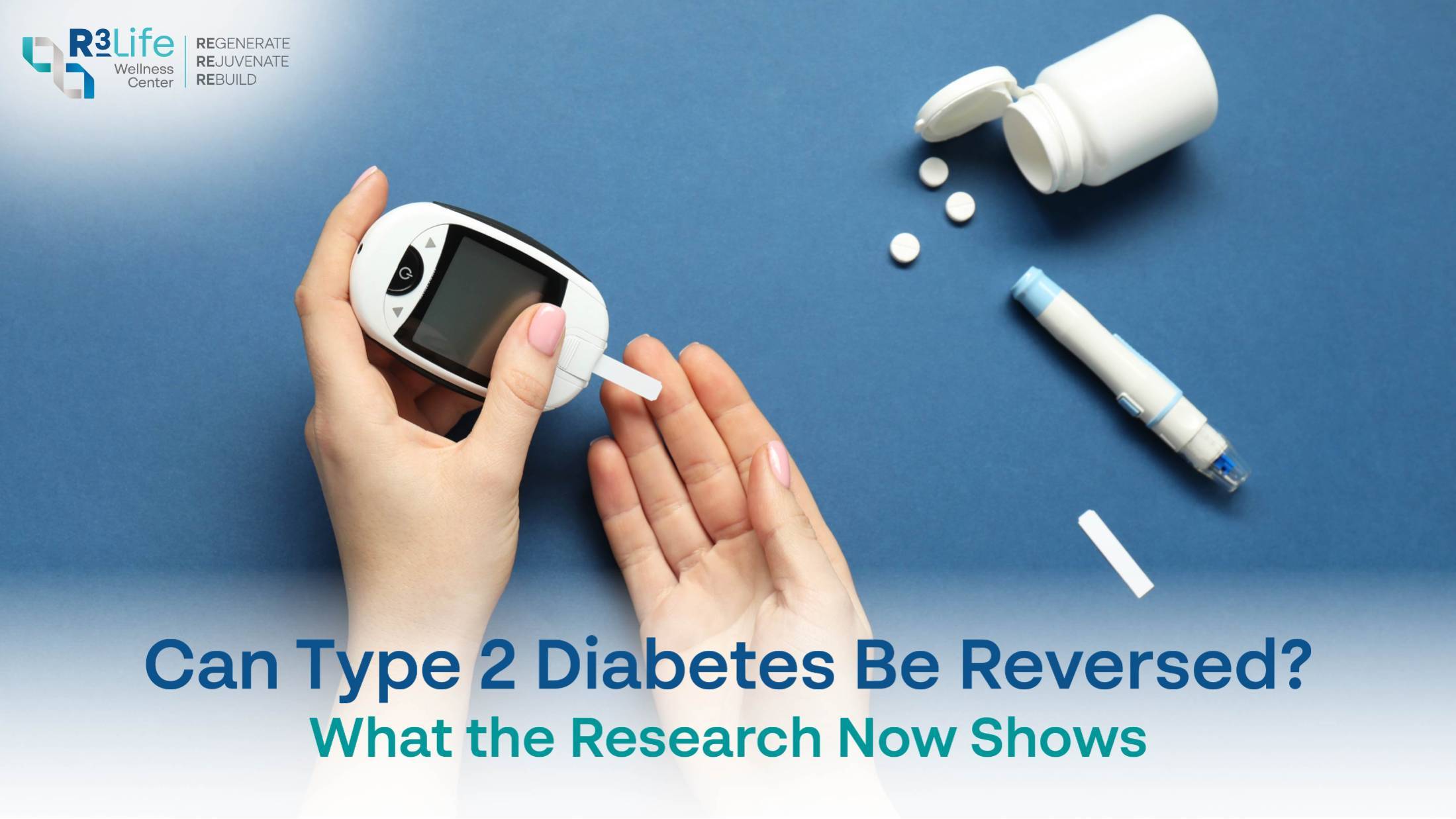
Can Type 2 Diabetes Be Reversed? What Research Actually Shows
The Difference Between Remission, Reversal, and a Cure
These three words are often used interchangeably, which causes a lot of confusion. Getting them straight is the key to reading the research clearly.
- Remission means blood sugar has returned to a healthy range, an HbA1c below 6.5%, (48 mmol/mol) for at least three months without glucose-lowering medication. This is the internationally agreed definition, set by Diabetes UK, the American Diabetes Association, and the European Association for the Study of Diabetes.
- Reversal is used more loosely, usually to describe the same idea: that the metabolic problem can be turned back rather than only managed.
- Cure implies the condition is gone for good and cannot return. This is not how doctors describe type 2 diabetes today.
The important distinction is that remission is not permanent. Blood sugar can climb again, particularly if weight returns. That is why the question "is type 2 diabetes curable" does not yet have a simple yes, even though meaningful improvement is very possible.
What Lifestyle Interventions Can Achieve
The strongest evidence for reversing type 2 diabetes comes from studies focused on weight loss.
In a widely cited UK trial, a structured weight-loss program helped almost half of participants reach remission at one year, with roughly a third still in remission after two years. Results were most durable in people who lost the most weight and who acted soon after diagnosis.
Longer follow-up showed that remission became harder to hold on to over five years. This underlines an honest point: reversal is achievable for many people, but maintaining it depends on sustained lifestyle change rather than a one-time fix.
Where the Research Currently Stands on Stem Cell Approaches
If lifestyle change achieves so much, what might regenerative medicine add? The findings so far are genuinely interesting, provided you read them closely.
Start with this: not all stem cell trials describe the same treatment. Some delivered cells through a catheter threaded into the arteries feeding the pancreas, a specialist hospital procedure. Others used a simple intravenous drip. Results from one do not carry over to the other.
The clearest picture for intravenous therapy comes from a trial that followed 91 adults for 48 weeks, all of whom had lived with type 2 diabetes for around eleven years without controlling it well despite insulin. Half received umbilical cord MSCs, half a placebo, and neither they nor their doctors knew which.
Compared with placebo, the treated group:
- Saw a larger fall in HbA1c (levels of sugar in your blood)
- Needed less insulin
- Showed improved insulin sensitivity
- Showed no improvement in their insulin-producing cells
That last point is the most illuminating. Blood sugar improved while those cells stayed exactly as they were, which points back to the picture described earlier: these cells work by improving the environment around the body's own machinery rather than rebuilding it. Understanding the mechanism is how a promising idea becomes a reliable one.
Two things keep it in proportion. The placebo group improved too, since everyone received close monitoring and dietary guidance. And the benefit peaked at nine weeks before easing back over the year.

How Stem Cell Therapy Fits Into Diabetes Management
What MSCs Do at the Metabolic Level
Most stem cell research relevant to type 2 diabetes uses mesenchymal stem cells (MSCs), which can be sourced from tissues including umbilical cord tissue
It is a common misconception that these cells work by turning into new insulin-producing cells. In the context of type 2 diabetes, their studied role is different. Rather than replacing cells, MSCs appear to act more like biological coordinators.
In simple terms, they release signaling molecules, including cytokines, growth factors, and tiny message-carrying packets called extracellular vesicles. Research suggests these messengers may influence inflammation, immune function, and how sensitive the body is to insulin.
Because chronic inflammation and insulin resistance sit at the heart of type 2 diabetes, researchers are interested in whether this kind of signaling support may help the body respond to insulin more effectively.
The Difference Between Type 1 and Type 2 Approaches
You may have seen headlines about people with diabetes becoming insulin-free after stem cell treatment. Almost all of these involve type 1 diabetes, which is a different condition with a different solution.
In type 1 diabetes, the immune system destroys the insulin-producing beta cells in the pancreas, leaving the body able to produce very little or no insulin. Unlike type 2 diabetes, it is not primarily caused by insulin resistance, so replacing those cells makes sense. Recent trials of lab-grown islet cells have allowed some participants to stop using insulin. This is an important scientific milestone, though it is still investigational and requires ongoing immune-suppressing medication.
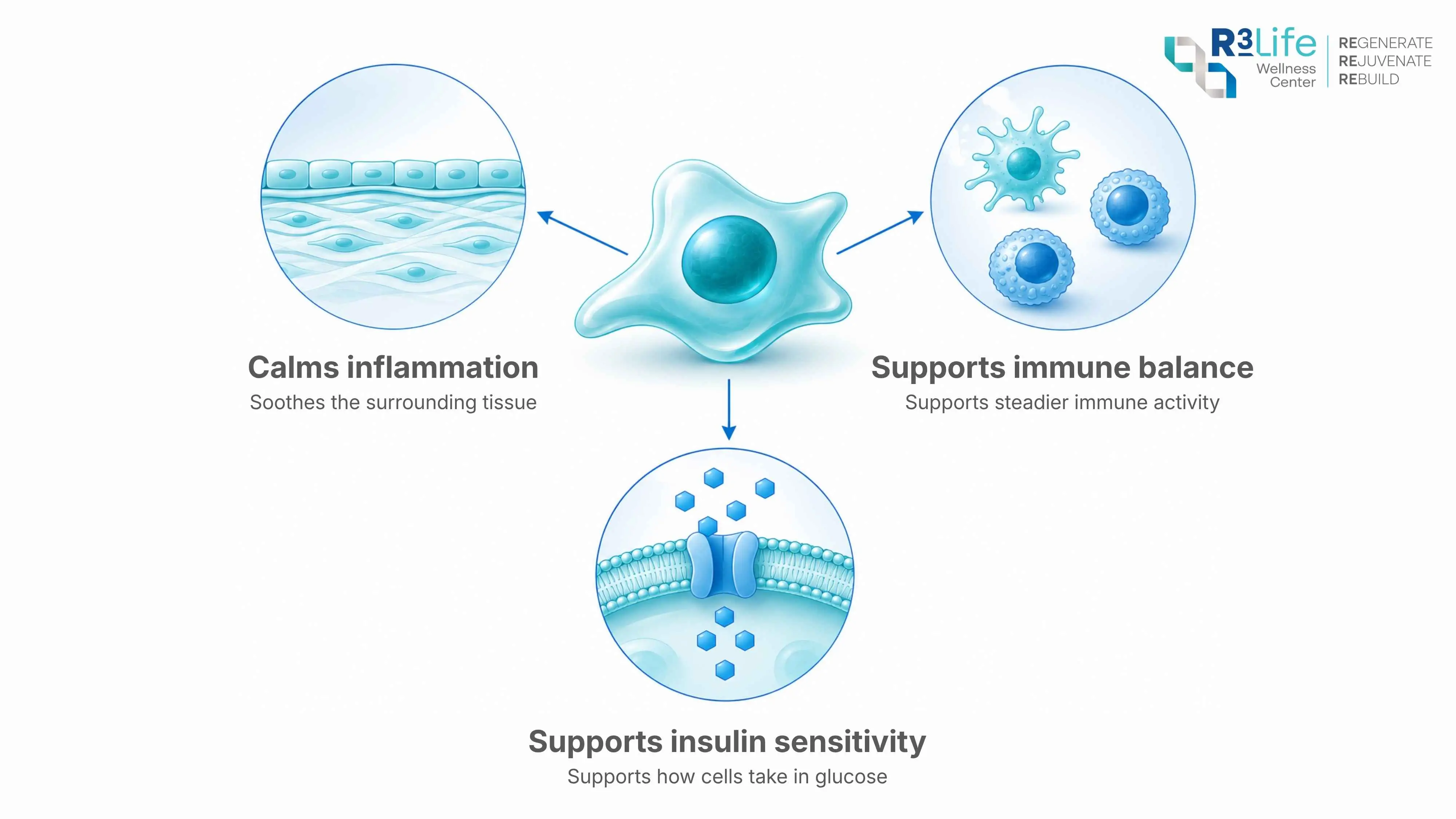
Type 2 diabetes is not about missing cells but about cells that resist insulin in an inflamed environment. That is why the stem cell strategies explored for type 2 focus on support and signaling rather than replacement. Mixing up the two conditions leads to unrealistic expectations.
What Realistic Expectations Look Like
Setting expectations honestly is part of responsible care.
- Stem cell therapy for type 2 diabetes is investigational, and is best viewed as a possible complement to lifestyle change and prescribed treatment, not a substitute for them.
- Any benefit reported so far tends to be modest and varies from person to person.
- Ongoing medical supervision and continued blood sugar monitoring remain essential throughout.
Approached this way, regenerative options can be considered thoughtfully rather than as a shortcut.
A Regenerative Approach to Metabolic Health
How Stem Cell Support Complements Conventional Care
At R3 Life Wellness Center, stem cell therapy is offered within this evidence-aware framework, as one part of a wider metabolic health plan rather than a standalone promise.
R3 Life Wellness Center works with two mesenchymal stem cell sources, Cord Tissue-MSCs and Amnion-MSCs, both obtained from screened, healthy donors and prepared to strict laboratory standards. In a metabolic context the intention is supportive, drawing on the anti-inflammatory and signaling properties that current research is exploring, to complement conventional care and healthy lifestyle changes.
This is always framed as complementary. The changes that give the best chance of remission in type 2 diabetes remain the foundation: structured weight loss, sustainable dietary changes, and regular physical activity, guided by your own physician. Any supportive therapy is added on top of these, never in place of them or of prescribed medication and regular monitoring.
What a Consultation at R3 Life Wellness Center Covers
Because every case of type 2 diabetes is different, a careful assessment comes first.
- A review of your medical history, current medications, and recent blood sugar control.
- Screening, such as a Pre-Stem Cell Blood Test, to confirm that therapy would be appropriate and safe for you.
- An honest discussion of what the current evidence does and does not support.
- A personalized plan that keeps lifestyle and conventional care at the center.
Registered nurses and the medical team guide the process from start to finish, with realistic expectations set from the very beginning.

Frequently Asked Questions about Diabetes and Stem Cell Therapy
Q: Is type 2 diabetes curable?
A: Not in the sense of being permanently gone. Type 2 diabetes can enter remission, where blood sugar returns to a healthy range without medication, but it can come back. For that reason, doctors describe it as manageable and sometimes reversible rather than curable.
Q: Can stem cell therapy cure diabetes?
A: No. Research on stem cell therapy for diabetes is still early and investigational. Some studies show modest improvements in blood sugar control, but no stem cell treatment has been proven to cure type 2 diabetes. It is best seen as a complementary, supportive option under medical supervision.
Q: Is stem cell therapy the same for type 1 and type 2 diabetes?
A: No. Type 1 research focuses on replacing the insulin-producing cells the body has lost, while type 2 research focuses on cells that may help reduce inflammation and support insulin sensitivity. They are different strategies for different problems.
Q: Should I stop my diabetes medication if I try stem cell therapy?
A: No. You should never stop or change prescribed medication without your doctor's guidance. Regenerative approaches are studied as a complement to conventional care and lifestyle, not a replacement for them.
Q: How soon after diagnosis should I act if I want a chance at remission?
A: The evidence suggests that earlier is better. People who address weight and lifestyle sooner after diagnosis tend to have better odds of reaching remission, although individual results always vary.
Conclusion
The encouraging news is that type 2 diabetes is often more changeable than people assume. Remission is a realistic goal for many, especially with early and sustained lifestyle change, even though a permanent cure is not yet part of the medical picture. Stem cell therapy for diabetes adds a promising but still investigational avenue, one that works best as a complement to proven care rather than a miracle solution.
If you would like to understand your own metabolic health and whether a regenerative approach could support your plan, the medical team at R3 Life Wellness Center can help. To learn more or arrange a consultation, visit https://r3lifewellness.com or message R3 Life Wellness Center on WhatsApp at +66 88 689 8888.

 Stem Cell Hair Loss Treatment: The Honest Truth