Beyond EEG: How Brain Wearable Technology Is Shaping the Future of Longevity
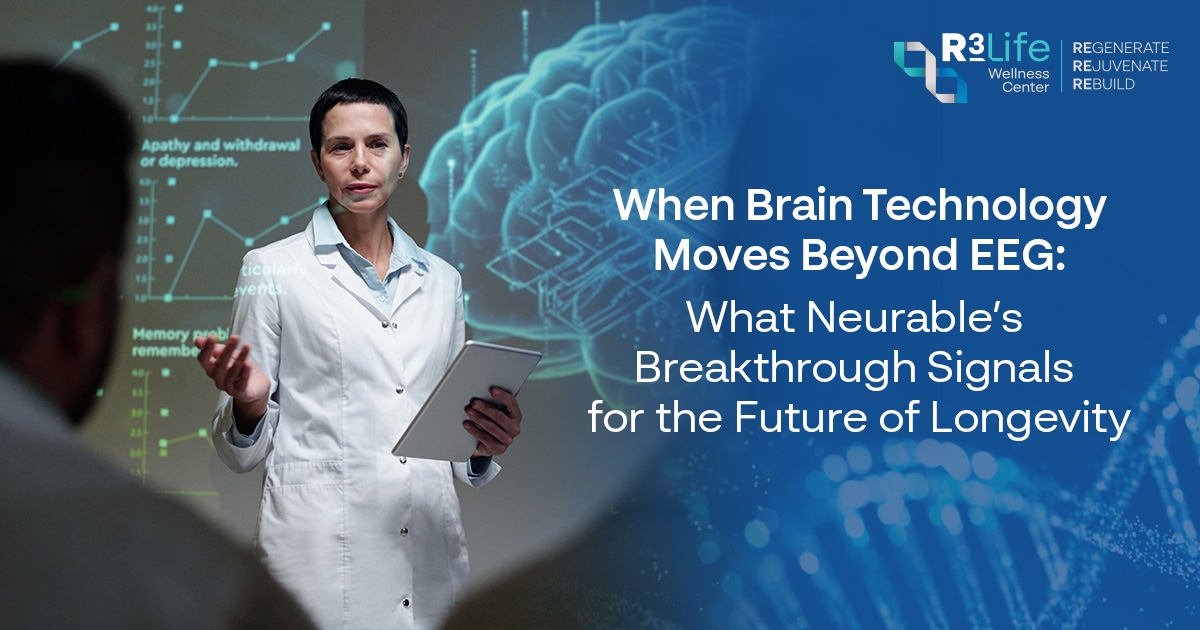
Over the past month, the longevity technology landscape has begun paying close attention to Neurable, a U.S.-based brain technology company that recently raised USD 35 million to advance wearable devices capable of reading brain signals without relying on traditional medical-grade equipment.
What makes this development noteworthy is not the funding alone, but the fundamental question Neurable is posing to the field of brain health:
Do we really need to measure the brain only inside laboratories and hospitals?
Who Is Neurable and What Are They Building?
Neurable was founded by Dr. Ramses Alcaide, a neuroscientist and expert in Brain-Computer Interface (BCI) technology. The company originated from research focused on decoding brain signals to control devices without invasive procedures.
Neurable’s core mission is to take BCI technology out of the lab and into everyday life.
Instead of traditional EEG setups that require gels, electrodes, and clinical environments, Neurable designs wearable brain-sensing devices, such as headphones, that people can realistically use in daily settings without medical preparation or supervision.
.jpg)
How Is This Different From Traditional EEG?
EEG (Electroencephalography) has been used for decades to measure electrical activity in the brain via electrodes placed on the scalp. It plays a crucial role in diagnosing neurological conditions.
However, EEG comes with clear limitations:
- Requires specialized medical equipment
- Must be conducted in hospitals or laboratories
- Captures brain activity only during short sessions
- Fails to reflect how the brain functions in real-life environments
Neurable is not attempting to replace EEG. Instead, it is changing the objective from clinical diagnosis to brain state awareness.
.jpg)
From Measuring Signals to Understanding Brain States
Rather than focusing on raw electrical waves, Neurable analyzes patterns of brain activity such as focus, mental fatigue, and cognitive workload using AI-driven models.
By integrating brain-sensing technology into everyday wearables, Neurable enables continuous, real-world brain monitoring, allowing insights into how the brain responds to actual daily demands.
This shift reflects a broader evolution in brain health:
from episodic measurement to contextual, continuous understanding.
Why This Matters for Longevity
Modern longevity medicine increasingly recognizes that cognitive decline rarely appears suddenly. Long before noticeable symptoms, subtle warning signs often emerge:
- Reduced concentration
- Chronic mental fatigue
- Slower decision-making
- Cognitive burnout
Technologies like Neurable are not designed to treat disease but to help individuals recognize early signals that their brain may be under prolonged strain.
In longevity science, early awareness often matters more than late intervention.
Technology Reveals the Signals Biology Sustains the Brain
Brain health wearables and AI-driven analytics help us detect when the brain is under stress. But from a preventive medicine perspective, awareness is only the first step.
Long-term cognitive performance still depends on the brain’s biological environment, including:
- Cerebral blood flow and oxygenation
- Cellular-level nutrient availability
- Inflammation control
- Oxidative stress regulation
This is why many longevity-focused clinics are shifting attention toward internal biological support for brain health.
At R3 Life Wellness Center, under the medical leadership of Dr. Ploy, our team develops physician-supervised IV drip formulations designed to support the internal environment necessary for optimal brain function. These protocols are not positioned as treatments for neurological diseases, but as supportive strategies for cognitive resilience and performance.
Brain Health IV Drip: A Supportive Longevity Approach
Our Brain Health IV Drip is formulated with small peptides and amino acids selected for their ability to cross the blood–brain barrier and support neurotrophic activity, contributing to:
- Neuroprotection: Supporting brain cells against toxic and ischemic stress
- Neuroplasticity: Enhancing the brain’s ability to adapt, learn, and reorganize neural networks
- Neurogenesis: Supporting the regeneration of neural precursor cells
- Metabolic regulation: Optimizing energy utilization within brain cells
Within this context, technology creates awareness, while biology sustains performance.
.jpg)
Future-Readiness in the Longevity Era
Neurable’s innovation represents more than a new product; it signals a broader shift in how we approach health and longevity.
Smart devices may tell us when the brain is fatigued, but maintaining cognitive readiness over decades requires systematic internal support.
Longevity is no longer about choosing between technology and medicine—it is about integrating both in a complementary way.
The real question becomes:
How effectively can you translate technological awareness into daily biological care?
FAQ: Frequently Asked Questions About Brain Technology and Longevity
What is brain wearable technology, and how is it different from traditional EEG?
Traditional EEG requires clinical-grade equipment, gels, and a hospital or lab setting to capture short-session brain activity. Brain wearables, like those being developed by Neurable, use embedded sensors in everyday devices (such as headphones) to monitor brain states continuously in real-world environments.
What does Neurable's technology actually measure?
Rather than recording raw electrical brainwave data like a standard EEG, Neurable's AI-driven system analyses patterns of brain activity such as focus levels, cognitive workload, and mental fatigue, as they occur during daily life.
Can brain wearables detect early signs of cognitive decline?
Brain wearables are not diagnostic medical devices, but they can help surface subtle signals — such as persistent mental fatigue, reduced concentration, or slower cognitive processing
Conclusion
Neurable’s recent funding round reflects a growing global realization: longevity is not merely about living longer, it is about maintaining functional, cognitive, and emotional capacity throughout life.
Living to 100 years old means little if memory, clarity, and independence are lost along the way.
In the world of longevity, preparation does not begin with devices it begins with understanding and supporting the brain from within.
Because ultimately, longevity is not measured by the number of years lived, but by the number of years the mind remains clear, capable, and fully engaged with life.

 Medical Tourism Partner in Thailand | R3 Life Wellness