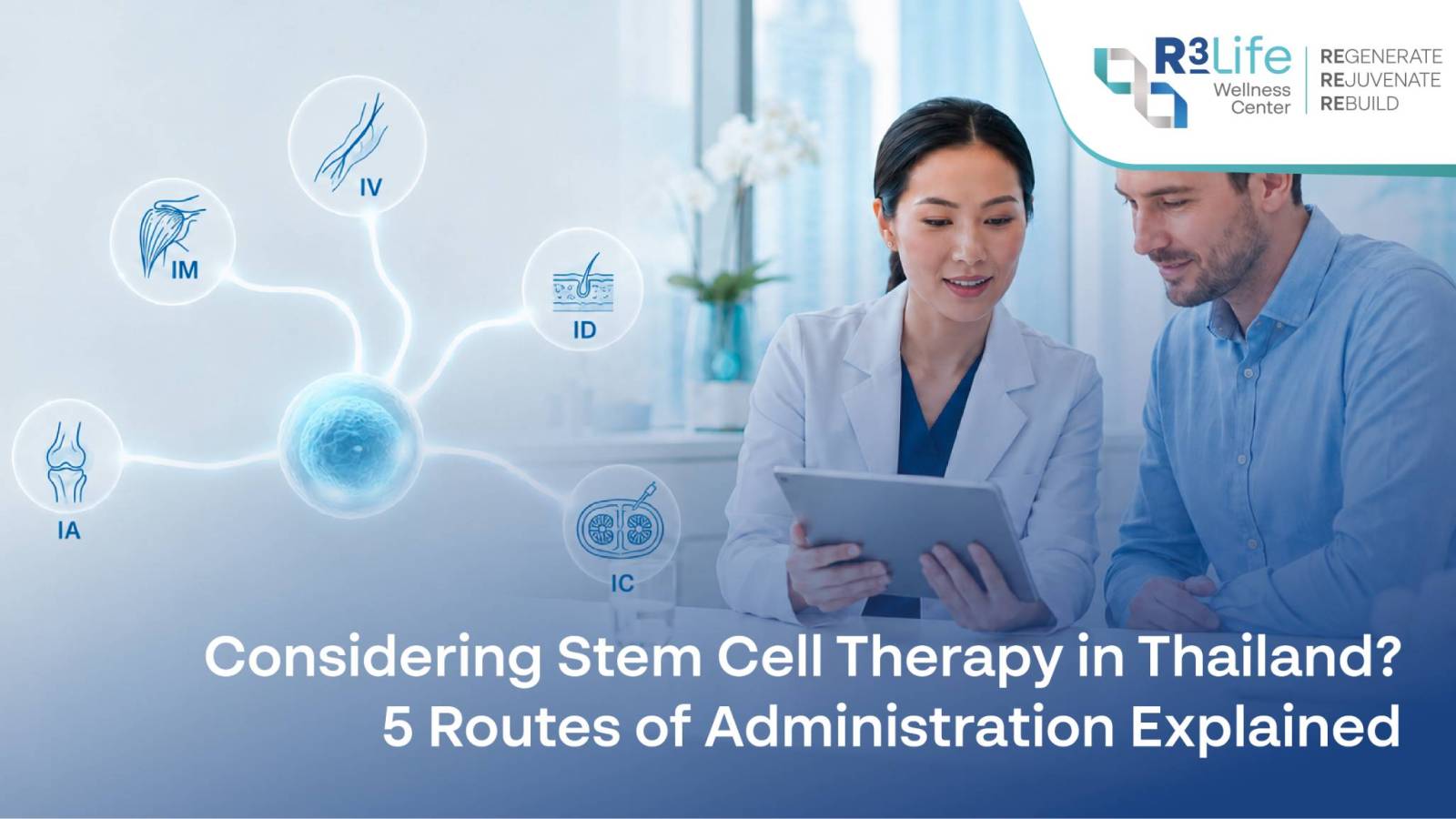
Considering Stem Cell Therapy in Thailand? 5 Routes of Administration Explained
Considering Stem Cell Therapy in Thailand? 5 Routes of Administration Explained
5 Key Takeaways
- Stem cell therapy is not one standardized procedure. Mesenchymal stromal/stem cells (MSCs) may be administered through different routes, including IV, IM, ID, IA and IC.
- The route of administration affects cell biodistribution. It can influence where cells travel first and how close they begin to the intended tissue.
- Stem cells do not work like a GPS. MSC homing and paracrine signaling are studied biological mechanisms, but they do not guarantee that cells will reach or repair a specific target.
- There is no single “best” route for everyone. The appropriate approach depends on the intended use, cell type, source, quality and quantity, individual health, potential risks and available evidence.
- Safety should come before treatment decisions. For international patients considering stem cell therapy in Thailand, understanding the cells, administration route, supporting documentation, risks and medical rationale is an important part of making an informed decision.
If you are considering stem cell therapy in Thailand, you may already be researching the type of stem cells used, how many cells may be needed or which stem cell clinic in Bangkok to consult.
But another important question is often overlooked: How will the cells actually be administered?
Stem cell therapy is not a single standardized procedure. Depending on the medical or research context, cells may be introduced into a vein, muscle, skin, joint or specific tissue.
The route of stem cell administration can influence cell biodistribution where cells travel first and how close they begin to the intended tissue. However, route alone does not determine clinical outcomes. Cell type, source, quality, quantity, individual health, intended use and supporting evidence all matter.
For international patients already in Thailand or planning to travel to Bangkok for a consultation, understanding these differences can help you ask more informed questions before making a treatment decision.
This article focuses mainly on mesenchymal stromal/stem cells (MSCs). The inclusion of these five routes does not mean that every method is a standard treatment, authorized for every indication or appropriate for every individual.
How Do Stem Cells Work After Administration?
Stem cells are sometimes described as if they can find damaged tissue like a GPS. The biology of mesenchymal stromal/stem cells (MSCs) is more complex.
Three concepts are particularly important:
Biodistribution describes how administered cells spread through the body. The administration route can influence which tissues or organs they encounter first.
Homing describes biological processes associated with MSC movement toward signals released by certain injured or inflamed tissues. It does not mean that every cell will accurately reach and repair a specific target (Zhang et al., 2021).
Paracrine signaling and immunomodulation refer to ways MSCs may communicate with surrounding cells and influence aspects of the tissue and immune environment through signaling substances such as cytokines, growth factors and extracellular vesicles (Gnecchi et al., 2005).
In short, the administration route matters, but it is only one part of a much more complex biological process.
5 Routes of Stem Cell Administration
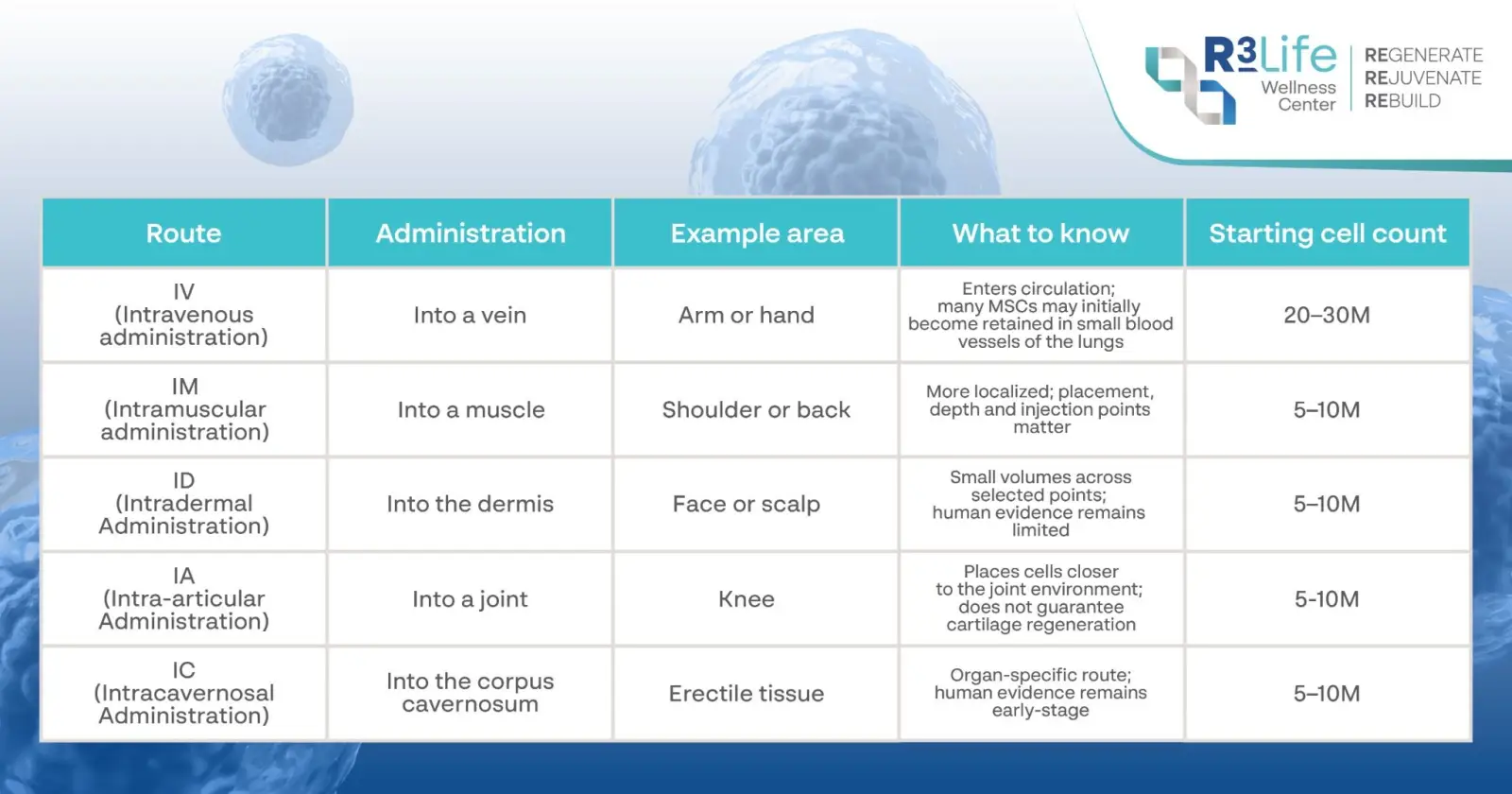
These are starting ranges used by R3 Life, not universal dosing standards. The appropriate cell quantity, if any, must be determined individually by a physician.
1. IV Stem Cell Therapy: Intravenous Administration
IV stem cell therapy delivers cells through a vein and introduces them into the circulation.
However, many MSCs may initially become retained in small blood vessels of the lungs, known as the pulmonary first-pass effect. IV administration therefore does not mean that cells will distribute evenly throughout the body or automatically reach a desired organ (Fischer et al., 2009).
2. IM Stem Cell Injection: Intramuscular Administration
Intramuscular administration (IM) delivers cells directly into muscle tissue. The physician determines the location, depth and number of injection points.
This approach begins closer to a selected tissue rather than introducing cells through the wider circulation first. Evidence varies according to the proposed use, and findings from one medical context should not be generalized to others (Park et al., 2025).
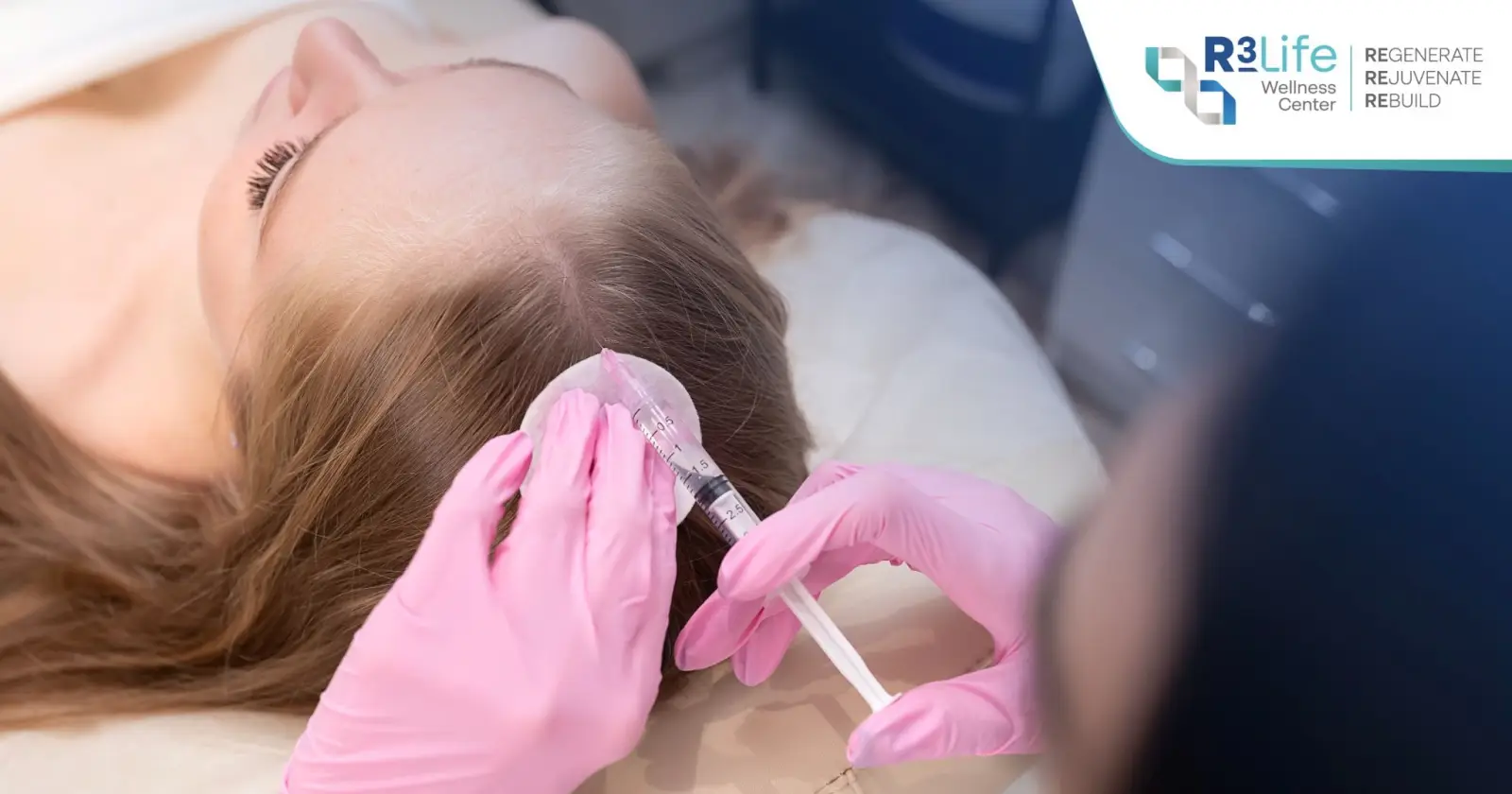
3. ID Stem Cell Injection: Intradermal Administration
Intradermal administration (ID) involves injecting small volumes into the dermis, such as selected areas of facial skin or scalp.
ID administration has been studied in skin- and scalp-related contexts, but available human evidence remains limited. It should not be assumed that intradermal stem cell injections will produce skin or hair outcomes in every individual (Ichihashi et al., 2023; Czarnecka et al., 2021).
4. IA Stem Cell Injection: Intra-Articular Administration
Intra-articular administration (IA) delivers cells directly into a joint. The knee is one of the most frequently studied areas, particularly in research involving knee osteoarthritis.
The rationale is to place cells closer to the joint environment. However, research findings remain mixed, and a stem cell injection for the knee should not be described as a method that can reliably or automatically regenerate cartilage (Tong et al., 2025).
5. IC Stem Cell Injection: Intracavernosal Administration
Intracavernosal administration (IC) delivers cells into the corpus cavernosum.
This route has been investigated in selected areas of male sexual health, including erectile dysfunction. Human evidence remains early-stage, and findings should not be generalized to every individual or every cause of erectile dysfunction (Haahr et al., 2016).
Considering Stem Cell Therapy in Thailand? Safety Comes First
For international patients comparing stem cell treatment in Thailand, the decision should involve more than treatment names, cell counts or price.
At R3 Life Wellness Center, your safety is our priority which's one of the principles that guides every medical decision. This does not mean that any medical procedure is risk-free. It means assessing whether an intervention is medically appropriate, understanding its potential risks and limitations, and being willing not to proceed when there is insufficient medical justification.
Before deciding on a cell-based intervention, consider asking:
- What type and source of cells are being used?
- What information is available about cell quality, viability, storage and transportation?
- Why is this administration route and cell quantity being proposed for me?
- What evidence supports the intended use?
- What are the potential risks, limitations and alternatives?
- How will I be monitored and followed up after the procedure?
For international patients, these questions are particularly important before arranging travel around a proposed treatment.

Stem Cell Consultation in Bangkok: Why Cell Source Matters
At R3 Life Wellness Center in Bangkok, our consideration goes beyond the number of cells or route of administration. We also care about where the cells begin.
For cells arranged through R3 Life, we take a more selective approach to sourcing. Rather than simply receiving donated birth tissue through a hospital partnership, we know the donor mother behind the source and place importance on her health and well-being as part of our sourcing considerations.
From there, the cells are handled through selected laboratory partners in Thailand, allowing the collection, processing, preparation and transportation pathway to remain within a network we know and work with.
For patients who already have stem cells stored in Thailand, R3 Life currently accepts cells only from selected partner cell banks whose cell-handling and storage processes we are familiar with and trust, subject to physician review and suitability for the individual case.
Keeping the process within Thailand also helps reduce unnecessary transportation time and allows fresh cell preparation to be coordinated closer to the planned administration.
For R3 Life, patient safety starts long before the cells arrive at the clinic—from being selective about where they come from and who we work with, to how they are prepared and ultimately whether their use is medically appropriate for each individual.
Safety is not a promise that a procedure has no risk. It is a commitment to evaluate those risks carefully, communicate them clearly and place medical appropriateness ahead of simply performing a treatment.
FAQ: Stem Cell Therapy in Thailand
1. Which route of stem cell therapy is best?
There is no single best route for everyone. The decision depends on the intended use, individual health, cell type and quality, proposed quantity, potential risks and available clinical evidence.
2. Is IV stem cell therapy better than a local stem cell injection?
Not necessarily. IV and local administration have different biodistribution patterns and have been studied in different contexts. The appropriate route, if any, should be determined individually.
3. Can stem cells travel to a problem area on their own?
MSCs may respond to biological signals associated with injured or inflamed tissues through processes related to homing. This does not mean every cell will reach a specific target with precision.
4. What should international patients check before choosing stem cell therapy in Thailand?
Consider the cell type and source, quality documentation, physician assessment, rationale for the proposed route and quantity, available evidence, potential risks and follow-up arrangements—not only the price or number of cells offered.
Planning a Stem Cell Consultation in Bangkok
If you are currently in Thailand or researching stem cell therapy in Bangkok before travelling, you may arrange an initial physician consultation to discuss your medical information and what assessment may be appropriate.
A consultation does not mean that stem cell therapy will necessarily be recommended. Its purpose is to understand your individual situation and available options before making a decision.
Medical Disclaimer
This article is for general educational purposes only and is not medical advice, a diagnosis, a treatment recommendation or a guarantee of outcomes. Cell-based interventions and routes of administration must be assessed individually by a qualified physician with consideration of scientific evidence, potential risks, professional standards and applicable regulations.
 How do stem cells from the umbilical cord and placenta help restore the body better than other types?