The Early Signs of Cognitive Decline Most People Miss
Key Highlights
- Cognitive decline and normal aging are not the same thing, early cognitive decline symptoms include changes that go well beyond occasional forgetfulness.
- Mild cognitive impairment sits between normal aging and dementia, affects an estimated 15–20% of adults over 65, and often goes undiagnosed for years.
- Language difficulties and changes in judgment are early cognitive decline symptoms frequently overlooked because they don’t look like memory loss.
- Chronic inflammation, poor sleep, and unmanaged metabolic risk factors are among the leading drivers of cognitive decline that progresses faster than it should.
- Brain health support works best before significant symptoms appear, the earlier the intervention, the more options are available.
Quick Summary
You walked into a room and forgot what you wanted to search for; maybe it was your phone, your house key, or your car key. You shrugged it off thinking “Well it happens, maybe it wasn’t that important anyway” - only to end up circling right back because you can’t leave the house.
The problem with pathological cognitive decline is that the early signs don’t look like what people expect. They don’t arrive as dramatic memory loss or sudden confusion. They arrive as a new hesitation with words, a decision that seemed slightly off, a social withdrawal that gets explained away as tiredness. Easy to dismiss. Easy to explain. Which is exactly why they get missed.
This article covers those early signals, what they are, how they differ from normal age-related changes, and what you can do before they have the chance to progress.
What Is Cognitive Decline, and How Is It Different from Normal Aging?
Normal age-related cognitive decline is common, but the major concern comes when those changes cross a threshold where they start to affect daily function, decision-making, or the ability to retain new information. The distinction matters, because the response to each is very different.
Normal Aging vs. Cognitive Decline: Knowing the Difference
Normal aging typically includes:
- Taking longer to recall a name, but getting there eventually
- Needing more time to learn a new skill
- Occasional loss of concentration
- Slower processing speed or difficulty with multitasking
Cognitive decline looks different:
- Forgetting the name of someone you see regularly, and not recovering it
- Asking the same question within the same conversation, without awareness of the repetition
- Getting disoriented in a familiar environment
- Difficulty completing a task that used to be routine
The distinction isn’t how often something happens. It’s whether the ability to recover is intact.
The Spectrum: From Mild Cognitive Impairment to Dementia
Cognitive decline doesn’t arrive as full dementia. It typically follows a spectrum:
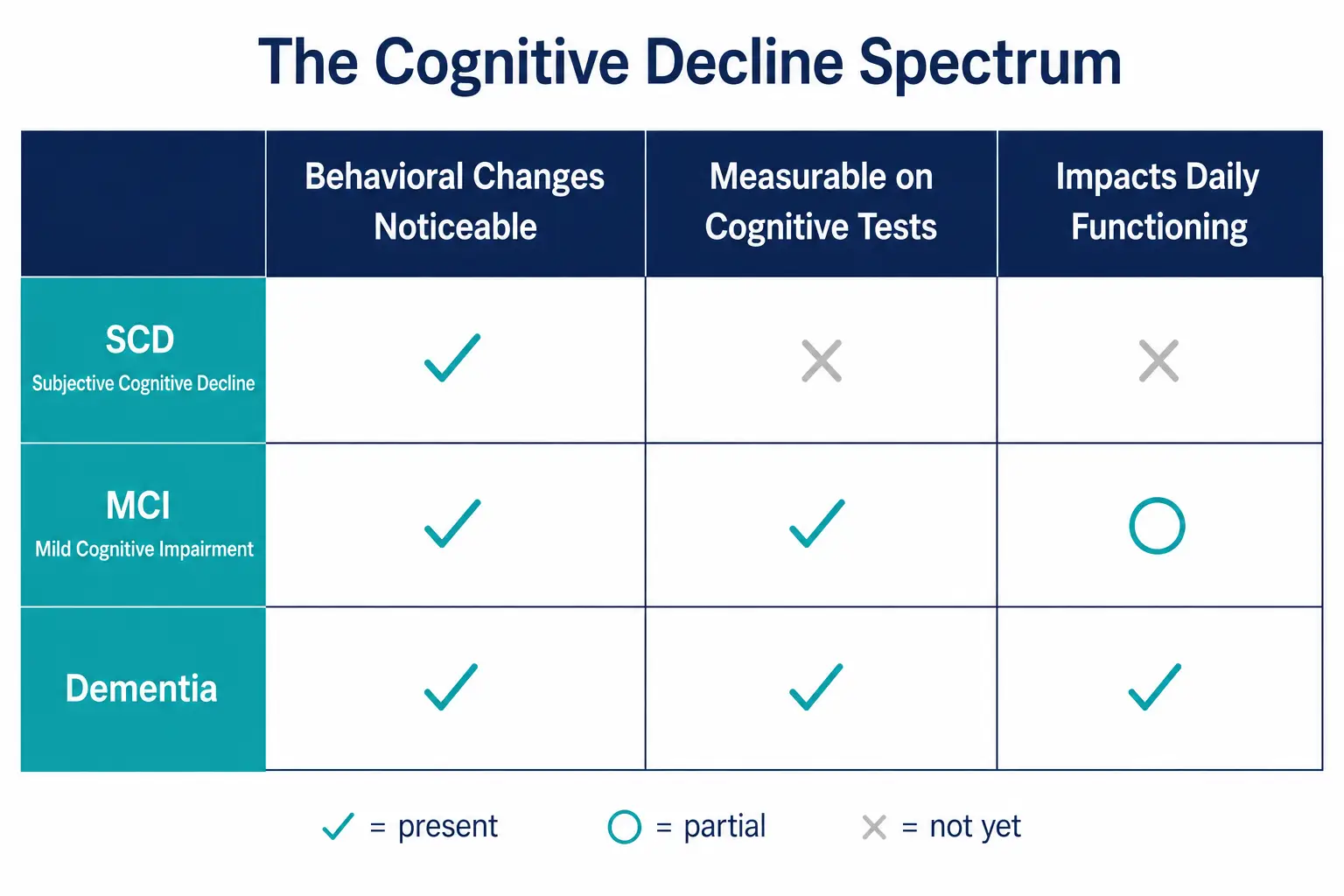
- Subjective Cognitive Decline (SCD): The individual notices changes, but standard tests show nothing measurable. Often dismissed as stress or anxiety, but worth taking seriously as an early signal.
- Mild Cognitive Impairment (MCI): Measurable cognitive changes that are noticeable but don’t significantly impair daily life. Affects approximately 15–20% of adults over 65. Roughly 10–15% of people with MCI progress to dementia each year, but MCI is also reversible in some cases, particularly when caught early.
- Dementia: Significant cognitive impairment that affects daily functioning, relationships, and independence. Alzheimer’s disease is the most common form.
The most important point: MCI is the stage where intervention tends to have the most impact. The window between early symptoms and a dementia diagnosis can be a decade or more.

Early Cognitive Decline Symptoms Worth Paying Attention To
The symptoms that tend to get missed are rarely the obvious ones. Here’s what to look for across four areas:
Memory and Learning Changes
- Difficulty retaining new information: things learned recently disappear faster than they should
- Repeating questions or stories within the same conversation, without awareness of the repetition
- Increasing reliance on reminders, notes, or other people to manage things that were previously handled independently
- Misplacing objects in unusual locations: keys in the refrigerator rather than by the door
The key signal here isn’t forgetting. It’s the inability to retrace the forgetting.
Language and Communication Difficulties
- Pausing mid-sentence to search for a word that should come easily
- Substituting wrong words without noticing it “pass me the thing” for an object you know well
- Following a fast-paced conversation becoming noticeably harder
- Reading comprehension declining faster than would be expected for age
Language difficulties are one of the most underrecognized early cognitive decline symptoms because they’re so easy to attribute to distraction or fatigue.
Changes in Judgment and Decision-Making
- Financial decisions that seem out of character: unusual purchases, unexpected generosity, or vulnerability to scams
- Difficulty weighing options or planning tasks that involve multiple steps
- Poor judgment around personal safety: leaving the stove on, forgetting to lock the door
These changes are particularly significant because they often surface in behavior before they show up on any cognitive test.
Mood and Personality Shifts
- Increased anxiety or irritability without a clear external cause
- Withdrawing from activities or social situations that were previously enjoyed
- Unusual passivity: reduced initiative or motivation that isn’t explained by depression
- Emotional responses that seem disproportionate to the situation
Personality shifts are frequently attributed to stress or “just getting older.” They deserve more attention than they typically receive.
What Accelerates Cognitive Decline Faster Than It Should
Lifestyle and Metabolic Risk Factors
Several conditions are strongly associated with accelerated cognitive decline:
- Type 2 diabetes and insulin resistance: the brain depends on stable glucose regulation, and metabolic dysfunction directly impairs it
- Hypertension: sustained high blood pressure damages small blood vessels in the brain over time
- Physical inactivity: movement supports neuroplasticity and cerebral blood flow
- Hearing loss: consistently under-addressed, and strongly associated with cognitive decline in later life
The Role of Chronic Inflammation and Oxidative Stress
Chronic, low-grade inflammation, the kind that persists without a specific cause, is increasingly understood as a significant driver of neurodegeneration. Inflammatory compounds can cross the blood-brain barrier and contribute to the kind of cellular damage associated with Alzheimer’s and other dementias. Oxidative stress adds to this by generating damage that the brain’s own repair systems struggle to keep up with over time.
Sleep, Stress, and Brain Health
Sleep isn’t just rest, it’s when the brain runs its cleaning cycle. During deep sleep, a network of channels called the glymphatic system flushes waste products out of brain tissue, including amyloid-beta proteins associated with Alzheimer’s disease. Chronically poor sleep reduces this clearance, allowing toxic proteins to accumulate faster than they’re removed.
Chronic stress compounds this. Sustained elevated cortisol: the body’s primary stress hormone is neurotoxic over time, with research showing measurable structural changes in the hippocampus, the brain’s primary memory center, in people with long-term stress conditions.

How to Support Brain Health Before Symptoms Progress
Evidence-Based Lifestyle Approaches
The research on cognitive decline prevention is more actionable than most people expect:
- Aerobic exercise 3–5 times per week is one of the most consistent interventions in the cognitive health literature
- Sleep hygiene: 7–9 hours, consistent schedule, reducing screen exposure before bed
- Cognitive engagement: learning new skills, social connection, mentally challenging activities
- Dietary patterns: Mediterranean and MIND diets show consistent associations with reduced dementia risk
- Cardiovascular health management: blood pressure, blood sugar, and cholesterol control directly affect long-term brain health
Clinical Support for Brain Health at R3 Life Wellness Center
For those who want to go beyond lifestyle changes, R3 Life Wellness Center offers targeted clinical approaches for brain health support:
- Brain Health IV: a clinically studied neuropeptide known for its neuroprotective properties, alongside targeted nutrients designed to support neurological function and address deficiencies that contribute to cognitive fatigue and brain fog
- NeuroBoost Prestige Duo: a combination protocol targeting cognitive performance and neuroprotection through targeted nutritional and cellular-level support
- Amnion-MSCs: at the more advanced end of regenerative medicine, mesenchymal stem cell therapy derived from amniotic membrane is being explored for its potential to support neurological tissue and modulate the neuroinflammatory environment associated with cognitive decline. For those looking beyond symptom management toward cellular-level restoration, it represents one of the more targeted options currently available in regenerative medicine. A specialized, consultation-led therapy.
The R3 Life approach starts with a thorough clinical assessment, including inflammatory markers, metabolic indicators, and a full symptom history, before any protocol is recommended. For anyone concerned about cognitive changes, a consultation is the right first step. Initial consultations are free of charge. Contact us on WhatsApp to book an appointment.
Frequently Asked Questions about Cognitive Decline
Q: What is cognitive decline?
A: Cognitive decline refers to a measurable decrease in mental functions including memory, language, attention, and decision-making. It exists on a spectrum from mild, age-related changes that don’t affect daily life, to significant impairment that does.
Q: What are the early cognitive decline symptoms to watch for?
A: The most commonly overlooked early signs include word-finding difficulties, changes in judgment or decision-making, mood shifts without a clear cause, and repeating questions without awareness of doing so. These often appear before obvious memory problems.
Q: Is forgetfulness always a sign of cognitive decline?
A: Not necessarily. Occasional forgetfulness, taking longer to recall a name, temporarily misplacing something, is a normal part of aging. The concern arises when forgetting is progressive, affects daily function, or involves recently learned information that can’t be recovered.
Q: What’s the difference between mild cognitive impairment and dementia?
A: Mild cognitive impairment (MCI) involves measurable changes that are noticeable but don’t significantly impair daily life. Dementia describes a level of impairment that does affect functioning and independence. MCI is an important stage, it’s where early intervention tends to have the most impact.
Q: At what age should I start thinking about brain health support?
A: Earlier than most people expect. Neurological changes associated with eventual cognitive decline can begin decades before symptoms appear. Proactive brain health support, both lifestyle-based and clinical, is most effective when it starts before significant symptoms emerge.
Conclusion
Cognitive decline rarely announces itself clearly. It tends to arrive quietly, a word that won’t come, a judgment call that seems slightly off, a social withdrawal that gets explained away. The gap between those early signals and a clinical diagnosis can be a decade or more. That gap is also the window where meaningful intervention is most possible.
If you’ve noticed changes in yourself or someone close to you, or if you simply want to be proactive about brain health before signs appear; R3 Life Wellness Center offers free consultations to help assess your current profile and put the right support in place. Reach out via WhatsApp at +66 88 689 8888 or visit r3lifewellness.com.

 Considering Stem Cell Therapy in Thailand? 5 Routes of Administration Explained