Heavy Metal Testing: Oligoscan or Blood Test? | R3 Life Wellness Center
KEY TAKEAWAYS
- Heavy metals accumulate in body tissues over time and are not always detectable through standard blood tests
- Blood tests measure what is currently circulating in your bloodstream — Oligoscan measures what has accumulated in your tissues
- Oligoscan is non-invasive, needle-free, and produces results in minutes
- The right test depends on what you are trying to find out and when
- R3 Life's Oligoscan also analyses essential minerals and vitamin levels — not just heavy metals
- If your results indicate elevated toxin levels, R3 Life doctors can recommend appropriate follow-up treatments from the existing menu
Quick Summary
Heavy metal exposure is more common than most people realize — and more of it accumulates silently in body tissues than shows up in routine blood work. This article breaks down the difference between blood testing and Oligoscan, what each method actually measures, and how to decide which one is right for your situation. If you are based in Bangkok or visiting Thailand and want a fast, non-invasive starting point for understanding your body's toxic load, Oligoscan at R3 Life is worth understanding before you book.
What Heavy Metal Testing Measures
Heavy metal testing matters because urban living, air pollution, certain foods, dental materials, and everyday environmental exposure all contribute to a slow accumulation of heavy metals in the body. Metals like lead, mercury, cadmium, and arsenic do not clear quickly on their own — they tend to deposit in tissues and build up over years.
Common symptoms associated with heavy metal accumulation include:
- Persistent fatigue that does not resolve with rest
- Brain fog and difficulty concentrating
- Unexplained muscle or joint pain
- Skin issues and poor complexion
- Digestive problems and low immunity
How Oligoscan Works
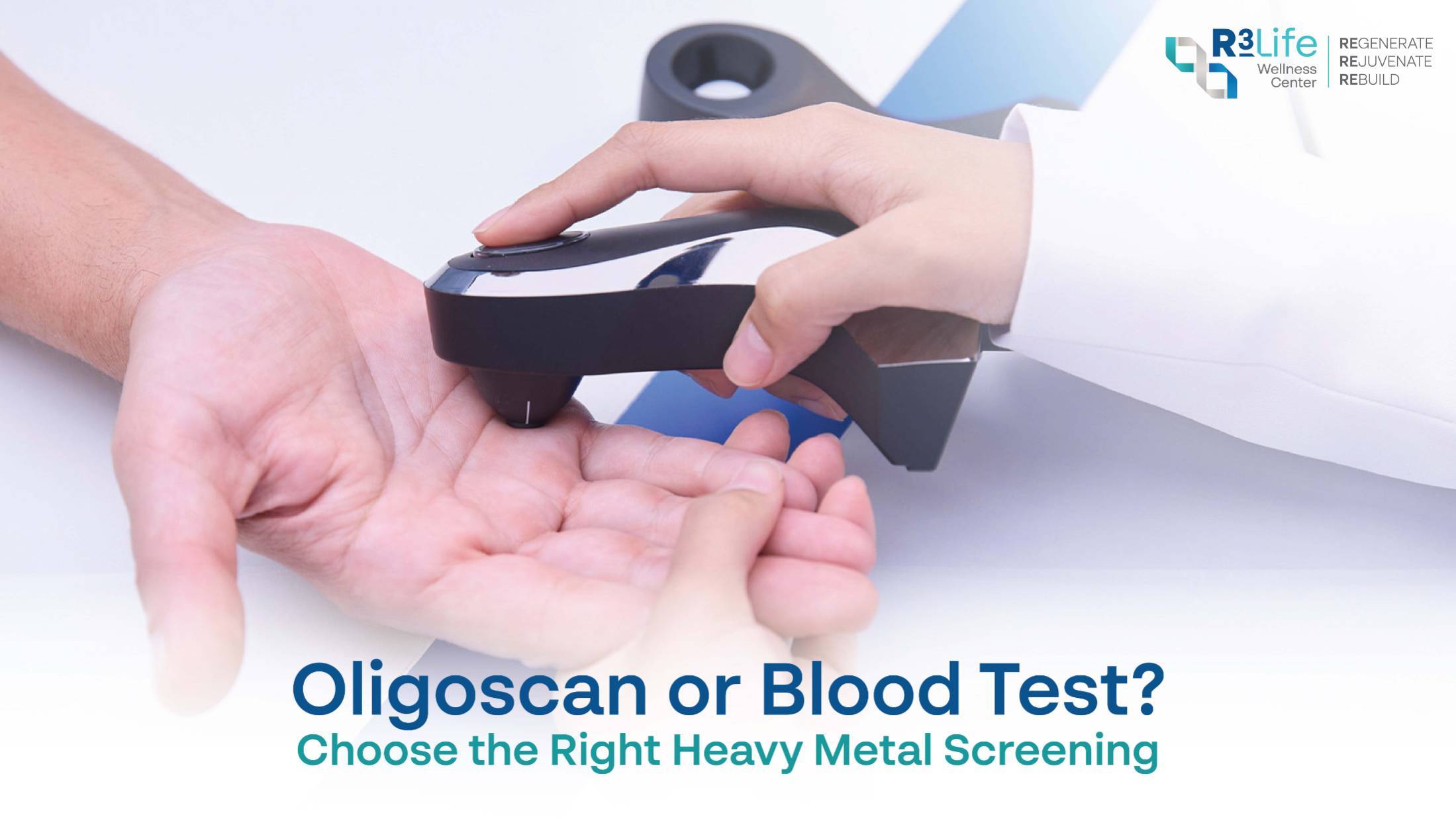
- Oligoscan uses a handheld device that emits light at specific wavelengths onto the palm of the hand. The device reads how different substances in the tissue absorb and reflect that light — a technique called spectrophotometry — and generates a detailed report on:
- Heavy metals — including lead, mercury, cadmium, arsenic, aluminium, and others
- Essential minerals — such as magnesium, zinc, selenium, and iron
- Vitamin levels — providing a broader picture of nutritional status
The test is completely non-invasive, takes approximately 5-10 minutes, and requires no blood draw. Results are available immediately.
Pros and Cons of Each Method
Pros and Cons of Each Method
Blood Test
- ✅ Useful for recent or acute exposure
- ✅ Widely available and familiar to most doctors
- ✅ Can be highly specific when the suspected metal is known
- ❌ Poor at detecting chronic, long-term accumulation in tissues❌ For those uncomfortable with larger blood draws, the sample volume required may be a consideration
- ❌ The process requires more time
Oligoscan
- ✅ Measures tissue-level accumulation — not just what is currently in the blood
- ✅ Non-invasive and results in minutes
- ✅ Covers heavy metals, essential minerals, and vitamins in one test
- ✅ Useful as a routine wellness screening tool
- ❌ Not a replacement for clinical blood testing in acute poisoning scenarios
- ❌ Spectrophotometry-based tissue analysis is a newer methodology — discuss with your R3 Life doctor if you have questions about its clinical application for your specific situation
Why Oligoscan Measures What Blood Tests Miss
The core difference comes down to where metals go after they enter the body.
Most heavy metals do not stay in circulation for long. After exposure, they are transported out of the bloodstream and deposited into tissues — bones, organs, and soft tissue. This is where they tend to remain, sometimes for years, contributing to chronic low-level inflammation and a range of non-specific symptoms.
A blood test taken in this window will often return clean results — not because the metals are gone, but because they have already moved out of the blood. Oligoscan reads the tissue directly, which is why it is better suited to identifying chronic accumulation rather than acute events.
Who Should Choose Oligoscan Over Blood Testing
Oligoscan is a strong choice if you:
- Have non-specific symptoms like nausea, fatigue, brain fog, or skin issues with no clear diagnosis
- Live or work in an urban or industrialised environment
- Want a fast, needle-free baseline screening without a hospital visit
- Are considering IV drip or detox treatments and want to understand your starting point
- Are interested in a broader picture that includes mineral deficiencies and vitamin status alongside heavy metals
Who Might Still Need a Blood Test
A blood test remains the more appropriate tool if you:
- Have had a known acute exposure to a specific heavy metal recently
- Are being monitored for occupational metal exposure
- Need clinical confirmation of a specific metal for medical treatment purposes
- Have been referred by a physician who requires blood-based data for diagnosis
What Happens After Your Oligoscan Results
If your Oligoscan results show elevated heavy metals or mineral deficiencies, R3 Life's medical team will walk you through what the findings mean and recommend a follow-up protocol tailored to your results.
R3 Life's most relevant treatments, priced from 2,500 to 6,500 THB, include:
- Meta Clear (Chelation Therapy) — eliminates toxins accumulated in the body and circulatory system, stimulates blood circulation, and helps reduce heavy metal burden
- Stress OxiShield & Relief — revitalizes a fatigued body from accumulated stress while eliminating waste and heavy metal toxins
- Liver Detox or Liver Fortify Plus — supports the liver's role in processing and clearing accumulated toxins
- Complete VitaMineral — addresses mineral deficiencies identified in the Oligoscan report
FAQ
Q: Is Oligoscan painful?
A: Not at all. The device is held against the palm of your hand and emits light to take its readings. There is no needle, no blood draw, and no discomfort.
Q: Can Oligoscan diagnose heavy metal poisoning?
A: This depends entirely on which metals or deficiencies are flagged and at what levels. Meta Clear (Chelation Therapy) is commonly used for heavy metal detox, but your doctor will build a protocol based on your specific results.
Q: Q: Where can I get heavy metal testing (Oligoscan) in Bangkok?
A: R3 Life Wellness Center offers Oligoscan heavy metal testing at its flagship clinic in Silom–Surawong, central Bangkok. The scan is non-invasive, reads accumulation directly from the palm with no blood draw, and takes only a few minutes. Your results are reviewed the same day by Dr. Tanaporn Eiamprapai (Dr. Ploy), R3 Life's Medical Director in Anti-Aging and Regenerative Medicine, who interprets your levels alongside your wider health picture before recommending next steps. From there you can arrange a consultation at the Silom–Surawong clinic.
Book Your Oligoscan at R3 Life
If you have been experiencing unexplained fatigue, brain fog, or other non-specific symptoms — or simply want to understand what has been accumulating in your body over the years — Oligoscan is one of the fastest and least invasive ways to get a clear picture.
The test takes 5-10 minutes. The results are immediate. And if follow-up is needed, R3 Life's medical team is equipped to guide you through the next steps.

 How to Improve Your HRV Without Chasing Numbers